Showing posts with label Environment. Show all posts

Thursday, October 26, 2017

The beauty and the beast of Harar - Part II

Due to negative stereotypes of hyenas conjured by cartoons and movies, I always thought that they were nasty and ugly-looking beasts. Surprisingly, they looked cute and adorable, especially their ears. They were round, fluffy and I assumed soft to the touch, not unlike the pandas’. Their spotted hairy coats looked clean and resembled those of tortoise-shell cats.
Balai and Solomon returned but they were not alone. They were followed by a pack of bigger hyenas. The hyenas were surprisingly a somber lot as none of them cackled as I thought they would. I guess feeding is serious business when it comes to the hyenas that have come to depend on the locals to fill their stomachs every day.
Solomon then took a weaved basket filled with long strips of raw red meat and sat cross-legged in the middle of the feeding site. The hyenas definitely knew the feeding protocol as none of them came rushing after the basket.
I couldn’t help but smile when I saw the image of a man spanking a hyena like a misbehaving child. I must say that such taming technique is by far more endearing than a whip used by circus folks.
It is also times like this when the cynicism in me vanished as I see the interaction and harmony between men and beasts.
Solomon then tried to spice up the feeding spectacle by feeding the hyenas directly from his mouth. This pleased the tourists a lot as they gaped and awed over it. The tourists were encouraged to do the same, guided carefully by Solomon. While only a few managed to brave it, others changed their minds at the very last second.
I personally didn’t try it, not because of fear. I was simply savouring the moment and for some reason, I was completely engrossed with my own thoughts to even notice how close I was to the hyenas and two had in fact brushed against my legs.
It was a chilling experience, sometimes I would wonder whether the hyenas might go on a wild rampage, but most of the time, just touched by the thought that human beings and wild animals can co-exist in harmony together, just the way nature has intended. I had tears brimming in my eyes.
The tears didn’t last long because unfortunately, this practice is now very much tourist-orientated.
Once every last strip of meat had been devoured by the hyenas, an overweight bald man stepped in to replace Solomon. For added value, the man gave several performances to demonstrate his chivalry and dominance over the hyenas, much to my disgust although to the delight of many other. He was forcing one of the hyenas to lie on the floor so that he could sit on it. In my mind, I thought there was no chivalry at all since the hyenas were all fed by then.
Adding salt to injury, in the middle of his performance, his mobile phone in his pocket went off and he answered it with a great sense of importance. For me, it just ruined the whole thing because then, it just proves how men will always want to dominate things. It also made a mockery out of the whole ritual by disturbing the elements of what had supposed to be a traditional practice in tune with nature. The co-existence and co-dependency between human beings and animals are being tossed out in the name of power and greed.
We left the site before the “show” ended in protest, believing that as tourists, we all have some level of responsibility. There are times when we should encourage the co-dependency and interaction between human beings and animals in order to preserve the latter’s existence. There are others when we shouldn’t and it was clear to me that the act of dominance and manipulation of animals by man just for the sheer pleasure of it is not one of them.
In the end, although disappointed by how the feeding had ended, I went home with a comforting thought. It is not often when we are touched by the act of human beings but sometimes that rare moments do come and it did come for me. When it comes, savour it and take the moment to see, listen and feel it with your heart. I didn’t even take any photos but what I saw that night will remain with me for as long as I live.
The author spent one year in Ethiopia and hated it in the beginning. She eventually learned to appreciate the country despite initial culture shocks and daily struggle to fan off stares by both men and women.

* The views expressed here are the personal opinion of the columnist.
- See more at: http://www.themalaysianoutsider.com/opinion/lim-ka-ea/article/The-beauty-and-the-beasts-of-Harar-Part-2-#sthash.iFyP32pC.dpuf

The beauty and the beast of Harar - Part I

As the sky bids farewell to the descending sun and welcomes the moonlight, Butar, Rajoo, Mimi, Kamer, Tika, Shimay, Deeish and the rest slowly appear out of nowhere. Like vampires, they only emerge when darkness falls upon the ancient city of Harar. It isn’t eerie but in fact, simply magical. They are hyenas, part of the local inhabitants that have roamed the city of Harar for centuries.
Like any other night, these hyenas make their way from the wild to the Fallana Gate, one of the designated feeding sites situated in the old city. At the site, they crouch and wait patiently to be fed by Hyena Men; Balai and Solomon, two brothers entrusted with the revered role of feeding the hyenas every night without fail.
Local legend has it that during the 19th century, a great famine hit the city of Harar. In order to make sure that the hyenas would not attack the local population and their valuable livestocks, continuous feeding of the hyenas during good times was thought to appease them. After more than 200 years, this tradition still exists today even though it may not be for the same purpose.
While doing some research about hyena feeding, I’ve noticed that most articles written about it failed to mention what made my own experience so magical and unforgettable; the calling of the hyenas. Unfortunately (or rather fortunately), most people who visit Harar to see the hyena being fed are never told about the enticing foreplay which leads up to the feast.
Before our visit to the feeding site that day, my photographer friend, Irada and I, walked around the old city; flapping our elbows around like mad women in an attempt to drive away the ubiquitous flies which would have otherwise congregated happily on the sight of any bare skin. What could be worse than the omnipresent stench of bodily wastes which seemed to permeate the air from all corners of the ancient wall? It took a lot of mind power to conquer the scent of the old city of Harar and it was definitely not for the faint-hearted.
One thing which I still appreciate about this Unesco World Heritage Site is how unashamedly primitive the city is; the Hararis still hang on to their traditional ways of life; including the method of waste disposal. It is dirty, smelly, crowded, noisy and completely devoid of any pretentious “tourist glitters”.
We were the first ones to arrive at Fallana Gate and our car was parked right at the front of the feeding site. I was delighted to see that the site was nothing more than any other regular residential area in Harar; simple and natural with the added value of a garbage dumpster by the side. I was a little apprehensive that the whole area would be “dolled up” to accommodate tourists.
While waiting, we also had the opportunity to interact with the local scruffy-looking children and their friendly mongrel pet, Sina, who was obviously excited from the looks of its wagging tail nineteen a dozen despite being used to the flocks of tourists arriving every year.
While sitting in our car waiting patiently for sundown, Balai came to greet us on his way to the cliff to start his faithful “courtship” with the hyenas. He was a surprisingly   young man in his twenties and all the time we thought that in order to earn the title of Hyena Man, one has to be elderly and distinguished. However, he did exude a certain calmness and maturity for someone that age.
After a very brief conversation with our driver, Balai walked away. Out of sheer curiosity and also boredom, Irada and I got off the car and followed him. After walking for about less than 100 meters, what appeared, but most importantly, what was heard before us truly tugged at the strings of our hearts.
First of all, the image was astounding. Balai and his younger brother, Solomon, both stood on two rock formations, which towered above what seemed to be a foliage of trees and corn plantations beneath. There were some small houses along the path leading deep into the forest. The sun was slowly setting and there was complete silence apart from the occasional indecipherable rhythmic calling of the hyenas. Balai and Solomon took turns to call for up to twenty names; apparently that was the size of the pack. We stood there, in a trance, listening to their voices.
Balai and Solomon ignored us but continued to perform this sacred ritual with full dedication and commitment. We became brazen by their oblivion towards us and took the liberty to get closer to them and subsequently climbed on top of the rocks. The view was simply breathtaking and the lighting from dusk had created a sense of romanticism which made the whole experience none other than a simple a love story between men and beasts.
After getting used to the sound of the hyena names, we couldn’t wait to see them. Being a cynic, I was waiting to witness whether any of these hyenas would actually answer to their names. We were told that the hyenas would travel a distance from as far as 10km! Occassionally, I saw a few locals walking unassumingly along the narrow path leading to the houses, completely oblivious to the sound of the men and unperturbed by the arrival of the hyenas at any time soon.
We waited with abated breath and after about 15 minutes, Solomon whispered to Balai and from his gentle gestures but urgent tone of voice, we knew they were coming. My heart started to throb with more frequency and I found myself holding my breath, waiting for something extraordinary to happen.
By then, Irada had left us by galloping down the hill towards the corn plantation, trying her luck to catch a close up photo of approaching hyenas. Only then, did Balai and Solomon become slightly agitated. In my heart, I thought, “Gosh, will it take only two stupid foreigners to mess up this ancient practice?”
As soon as I spotted a hyena slowly approaching from the corn plantation, I abandoned my thought immediately. I was so engrossed with seeing one in its natural surrounding, I had forgotten completely about the potential danger my friend faced! Then, another one appeared from a different direction as it slowly made its way to the top of the hill.
By then, Solomon quickly signalled Irada to come back. Soon enough, the sky was close to being dark and we were both asked to leave the site immediately. They had come and it was time for us to go.
We obediently left and waited by the side of our car. Other tourists were already gathered with their cameras ready for feeding time. As soon as it became dark, the headlights of our car were turned on to illuminate the site. Only then did I notice four sets of luminous eyes close by. They belonged to two hyena cubs crouching patiently not too far away, waiting quietly for the rest to arrive.
* The views expressed here are the personal opinion of the columnist.
- See more at: http://www.themalaysianoutsider.com/opinion/lim-ka-ea/article/The-beauty-and-the-beasts-of-Harar-Part-1#sthash.MABXUpzY.dpuf

Monday, March 4, 2013

From LoyarBurok: Two Women, Two Tribes and a Journey of a Lifetime [Part V]

Two Women, Two Tribes, and a Journey of a Lifetime is a 9-part series penned by Lim Ka Eaabout her one year stint in Addis Ababa, Ethiopia where she accompanied her husband on his 9th humanitarian mission. No stranger to travel and humanitarian missions herself, she learned that Ethiopia is not really Africa and Africa is not really all about national parks or long distance-runners. She also learned that being a "tai-tai" is so overrated unless there is another "tai-tai" to get into mischief with. This 9-parter tells the story of how two "tai-tais" explored Ethiopia and discovered their life as both an individual and a woman. This weekly series started with Part I: My first encounter with Africa, Part II: The faces, sounds and smell of Addis Ababa, Part III: The gift of a kindred spirit and Part IV: Getting in synch with nature.
Part V – Hardships and friendship
I’ve never really told Irada how I felt about this because at some level, I understand that a photographer has to take certain risks in order to capture that rare moment. Jalalem, on the other hand, was not as understanding. He was very much annoyed by our behaviour and possibly perceived them as parsimonious.  In the beginning, Jalalem would often ignore Irada’s urgent signal to stop the car when she saw something photo-worthy. We didn’t know whether it was his lack of urgency, understanding of English or he simply established that if we were not going to pay, he was not going to bother stopping.
My own frustration was of a completely different nature. It was extremely challenging for me to try to understand things in order to document our journey. Despite the fact that talking is free of charge here, it was difficult to communicate with some of the people we met since we did not have a translator. I am sceptical as to the accuracy of what had been translated to me by Jalalem and other local people who speak very little English.
In addition to this, the local women are often shy, possibly exacerbated by very low level of education and exposure to the outside world. They hardly spoke a word to us which made it even more difficult to interview them. If this was not the case, then very often, men spoke on behalf of them. Some women even shied away from being photographed although I would still approach them to talk to them. I had to raise both arms up with my palms wide open to reassure them that I had no camera with me.
Closer to the end of our trip, we finally established a better rapport and understanding with Jalalem. He provided us with some useful hints to facilitate our mission. He taught us the local tribal word, Jaala which means “friend”,  as a form of greeting, indicating friendship and solidarity. From then onwards, we could not stop screaming Jaala! Jaala! at almost everyone we saw on the way, much to their amusement but to Jalalem’s mortification. He also helped us to trade pictures for candies but this usually worked with children only.
Women source of life
Water and women – the vital sources of life
We were very often chased by half naked children in need of a good scrub, after our car and surprisingly with great speed. Their agility  and athleticism were only matched by their vocal chord as they screamed Highland! Highland! which to the unfamiliar ears, sounded like Thailand. Perhaps that is one of the reasons why Ethiopia has such a big pool of great runners.
Some boys even tried to attract our attention by doing a sort of local dance consisting of jumping jacks executed from a squatting position.  Trust me, it didn’t look easy and the Russians may be able to learn a thing or two from these boys. We later learned that due to the scarcity of water, empty plastic bottles or “Highland”, named after one of the popular local brands of bottled water, are in high demand in almost every part of the country. They are used to collect water from the river or even puddles of muddy water left behind by the rain. Forlorn-looking donkeys, used as mobile water tanks, were seen carrying bright yellow plastic jerry cans filled with water.
Local women are a vital source of life, not only because they are mothers, they are also responsible for the difficult task of collecting water. Almost throughout the whole journey, women are often seen walking for miles in order to reach water points or rivers, which are often completely dried up. Each woman, with a 20-litre jerry can strapped onto their backs, some pregnant and some riped with old age, take their task seriously as they often risk sexual harassment due to long distance of isolated paths taken to reach the water source. Humanitarian organisations have often tried to make sure that new water wells are being constructed as close as possible to their homes in order to avoid such risk.
It is heart wrenching to think that many of these pregnant women probably risk losing their unborn babies and some even their lives while delivering, due to such harsh condition. Reliable statistics have shown that the neo-natal mortality rate in Ethiopia is as high as 51 per 1,000 live births and the maternal mortality rate is at 720 per 100,000 live births.
Many women also suffer from gradual distortion of their backs due to the burden of such brutal weight. We had seen some elderly women walking and bearing the cruelty of life, with their backs bent forward permanently to almost a ninety-degree.
For many of us who never have to submit to such hardship, it boggles the mind to see how many of them could still muster a beautiful smile which weighed more than the weight they carry on their back by a million times.
Rainbow in Arba Minch
Arba Minch – “It’s a good sign”
We finally reached Arba Minch at around 4:30pm. Elevated at around 1,600m, it provides a spectacular view of the Rift Valley and nearby lakes from above. The largest city in the south-western part of Ethiopia, Arba Minch, means forty springs in Amharic, is indeed more developed and sophisticated than other places we have been outside the capital. It is well-known for three things, Nechisar National Park, Lake Abaya and Lake Chamo.
Our first experience with Lake Abaya and Chamo were truly magical. The lakes are divided by Nechisar National Park in the middle, also named fondly as the Bridge of Heaven, provides a startling contrast between the salmon pinkish water of Lake Abaya and the clear blue water of Chamo. The former’s water colour is a result of elevated natural concentration of suspended ferrous hydroxide.
What further amazed us was a rainbow, perfect in its shape, size and colour, arching over the lakes from one end to the other. If heaven really exists, then this was how I would have imagined it. Irada, who was previously apprehensive about her ability to obtain good photographs, told me that the rainbow was a good sign. She once gave me a brief lesson in photography and as I remember it well, she told me that to take a fantastic photograph, it often depends on three things; luck, lighting and composition. Anyone can hone the necessary skills or techniques to become a photographer but without luck, even the best photographers will not be able to secure an outstanding photograph. To her, it was purely luck that we had arrived in Arba Minch with this rare gift of a magnificent view.
After being deprived of fresh seafood in Addis Ababa, we feasted on grilled tilapias caught from the lakes. Nothing had ever tasted so good throughout the time I had spent in Addis Ababa. The fact that we were both starving could also be a contributing factor. The beers were nicely chilled and hence provided us with a delightful change from the often lukewarm beers in Addis Ababa due to the power cut.
By 8 pm, we were both sitting in our hotel room, completely bored and missing our family back in Addis Ababa. With no television or radio to provide us with some entertainment, we were engulfed in the complete stillness and silence of the night. With our 5 litres of untouched white wine staring at us from above a cabinet, we unanimously decided to drown our boredom in some alcohol. After several cups of bottoms up, we settled into bed early that night, exhausted but exhilarated at the same time after all the excitement in one day. Perhaps it was the white wine finally working its way through our system. Whatever it was, we sighed in contentment as we turned off the lights and bid each other goodnight.
As I closed my eyes, I thought about our impending camping trip at the Mago National Park with slight trepidation. I think what had worried me most about the journey was the constant warning of the threat of Sleeping Sickness caused by Tsetse flies in Mago. Once bitten, it apparently results in instant coma. But as I finally dozed off, I heard the echo of Irada’s voice saying, “It’s a good sign.” I thought, if the appearance of a rainbow could provide luck to a photographer, I hope it would provide the same for two women at Mago National Park.
Next: Part VI – Our first sighting of a local traditional tribe
Ka Ea used to be a globe trotter. She has lived in Timor Leste and Afghanistan while working as a civic education and human rights officers for the United Nations. She then tried to be a full time housewife in Ethiopia and Cambodia but failed miserably. Now, she works with lawyers and human rights activists by day and watches Discovery Travel & Living by night. She writes for The Malaysian Insider during her dwindling free time. She longs for the day when someone would pay her to travel, eat and write.
Irada Humbatova was born in Azerbaijan’s capital Baku on 12 July 1974. She trained and worked as a midwife from 1994 to 1997, later assisting the International Federation of the Red Cross/Red Crescent with maternal health work by training and supporting traditional birth attendants in rural areas. Since then she has followed her husband on Red Cross missions around the world, developing her love for photography into a passion and profession. Inspired by Africa’s immense beauty and its people’s suffering she moved from art photography to photojournalism. She has since grown to become Reuters’ stringer for Ethiopia and work on assignments for other news outlets and magazines. Irada is currently back in Baku continuing her work with Reuters. She contributes most of the photographs in this series.


Sunday, May 22, 2011

From LoyarBurok: Two Women, Two Tribes and A Journey of a Lifetime [Part IV]

Two Women, Two Tribes, and a Journey of a Lifetime is a 9-part series penned by Lim Ka Ea about her one year stint in Addis Ababa, Ethiopia where she accompanied her husband on his 9th humanitarian mission. No stranger to travel and humanitarian missions herself, she learned that Ethiopia is not really Africa and Africa is not really all about national parks or long distance-runners. She also learned that being a "tai-tai" is so overrated unless there is another "tai-tai" to get into mischief with. This 9-parter tells the story of how two "tai-tais" explored Ethiopia and discovered their life as both an individual and a woman. This weekly series started with Part I: My first encounter with Africa, Part II: The faces, sounds and smell of Addis Ababa and Part III: The gift of a kindred spirit.

Part IV - Getting in synch with nature

A short distance away from the industrial areas of Addis Ababa, we passed acres of green houses in Debre Zeyit, erected to accommodate the blooming flower industry of Ethiopia, soon overtaking Kenya as the biggest flower producer in Africa. Vertically stacked chopped-up eucalyptus trees lined both sides of the roads neatly. They are valued commodities, serving locals with many purposes; construction of houses, fencing, scaffolding and firewood.

We could start to breathe more easily due to lower altitudes and less air pollution although trucks ahead of us often blurred our frontal visions by leaving behind thick trails of dust which seemed to linger for more than 100 metres at a stretch, especially on unpaved roads.

The landscape varied intermittently from flat arid fields to luscious green and fertile highlands often with layers of man-made terraces to accommodate small agricultural crops. Acacia trees shaped like giant bonsai with their trunks and branches twisted on their own will, aloes and euphorbias were seen spreading sparsely in arid fields. Many acacia trees are used by birds to support their nests and men to hang their traditional cylindrical bee hives made of barks and dung to collect mar or honey.

What is Africa without its bastion of wild animals? We were constantly fascinated by the vast species of birds and animals flying and roaming freely in their undisturbed milieu. I wonder how long would it take before the white pelicans, helmeted guineafowls, vultures, falcons, marabou storks, camels, baboons and dik-diks begin to disappear in order to give way to homo sapiens’ insatiable appetite for development and eventually destruction.

Against a constant background of volcanic hills and the Arsi, Fike and Guge Mountains which seem to stretch for an eternity, clear blue sky invaded by fluffy white clouds, it was definitely a quiet and soothing retreat from the madding crowd of Addis Ababa.

Otherwise a landlocked and mountainous country, which often provides a sense of claustrophobia, the ubiquitous images of the Rift Valley lakes serve as a temporary soothing alternative.

With elevations varying from 450m to 1,700m, the temperature was inevitably erratic. It could rise as high as 40 degrees Celsius, as experienced in Mago National Park and Omorate, to as low as 20 degrees Celsius in higher grounds such as Wolayta and Jinka.

Between Arsi Negele and Shashemene, the landscape changed from the small deciduous leaves of acacia trees on barren soil to thicker foliages thriving on green carpets. We were delighted at the sights of luscious fuchsia-coloured bougainvillaea and crimson red poinsettia trees. Hedges comprised of small yellow-coloured daisies, locally known as Meskal Flower, lined both sides of the road.

"Blue donkeys" were replaced by herds of cows, goats and sheep under the watchful eyes of les petites shepherds. Occasionally, we saw young boys balancing their lean bodies effortlessly on flimsy-looking rubber-wheeled carts pulled by horses along the sides of narrow roads. It did provide an impression of an African version of Roman chariot racers.

In bigger towns like Shashemene and Wolayta, red or blue tuk-tuks, similar to those seen in India and Thailand, and horse drawn carriages serve as public transportations.

Tukul

Big concrete buildings are being substituted by tukuls, traditional round huts made from clay with conical grass thatched roofs (see picture above). The tukuls are often small and low, which made me wondered how many people it could actually accommodate. While I was concerned with the issue of space, Irada was occupied with a rather different thought, perhaps less grave but definitely more humourous in nature.

She turned to me and said solemnly, "It’s amazing that the cows are not eating the roof."

Shashemene, about 179km from Addis Ababa, is a busy and crowded town, a place where Rastafarians pay homage to. Although deeply disappointed by the absence of men with dreadlocks and marijuana plants, we were still charmed by the sound of bells dangling around the horses’ necks as they galloped along with their attached carriages filled with passengers. It sounded exactly like the sleighing bells of reindeers as often portrayed during the Yuletide season.

A few kilometres after Shashemene, we passed the village of Aje. The tukuls are now much bigger with some beautifully painted with drawings of the Lion of Judah, a revered imperial symbol representing the Emperors’ direct lineage of the Israelite tribes, both according to local legend and Rastafarian belief. There are others wearing some sort of locally made ornaments on top of their roofs.

Local men were seen wearing tall straw hats with orange, red and green horizontal stripes. We were told by Jalalem that these were Oromo men in their traditional hats.

After travelling for almost six hours, the asphalt roads finally ended as soon as we reached the town of Alaba Kulito.

No pain, no gain

While I struggled to take notes during the remaining bumpy journey, my writings were reduced to illegible child-like scribbles. Irada, on the other hand, was faced with a much harder and frustrating task at hand. Due to the influx of tourists over the years, local tribes have begun to take advantage of the benefits of tourism by charging 2Birrs (10Birr is equivalent to roughly 1USD) for each photo taken of them. Prior to our travel, we had been advised to agree on the terms of payment before taking any picture of the local people.

As a bona fide photographer, Irada aspires to capture her subjects in their natural state of being and environment, none of these artificial poses, thank you very much! However, as human beings begin to understand the power and ability of the camera to immortalise images, we also learn to limit the potential of appearing vulnerable and ugly by posing. As such, the locals often looked into the camera with sterile smiles imprinted on their faces.

In order to minimise such monotonous images, Irada often tried to take spontaneous snapshots surreptitiously in order not to alert the people. Unfortunately, unless you are a magician, it was impossible to hide a 24-70mm zooming lens. As soon as the locals saw her with her camera, they rushed towards her demanding for payment or worse, insisting her to take pictures of them so that they could earn some money. It didn’t really matter how far her subjects were because they would often run after her, shouting "2Birr! 2Birr!"

It didn’t matter either whether she had taken a picture of them or not because by having a camera automatically entitled them to assume that she had. Very often, our frustration and patience were taken to a new height when many locals insisted on being paid in fresh new notes.

There was an incident which created much discomfort in me although it didn’t affect Irada’s photographic instinct. As we were passing through a village, a Tsemay boy, dressed in his traditional best, attracted our attention from a distance. He was strolling along the road with a machete in his hand. Many of the local men and boys tend to carry spear-like weapons and AK-47s, as a form of protection against wild animals.

As our car moved slowly towards him, Irada started to take pictures of him. The boy started waving his machete in a fury as soon as he realised that a farenji woman was taking his pictures. Irada, completely unperturbed asked the driver to stop by the boy so that she could take a close up portrait of him. Meantime, the boy continued to wave his machete in front of Irada, obviously very upset judging from his verbal conduct and frantic gestures. Although I was sitting at the other side of the car, I was stricken with fear that the boy might just slash Irada with his machete.

Thankfully, nothing happened as soon as we drove away and left behind a rather angry and upset boy.

Next: Part V - Hardships and Friendship

Ka Ea used to be a globe trotter. She has lived in Timor Leste and Afghanistan while working as a civic education and human rights officers for the United Nations. She then tried to be a full time housewife in Ethiopia and Cambodia but failed miserably. Now, she works with lawyers and human rights activists by day and watches Discovery Travel & Living by night. She writes for The Malaysian Insider during her dwindling free time. She longs for the day when someone would pay her to travel, eat and write.

Irada Humbatova was born in Azerbaijan’s capital Baku on 12 July 1974. She trained and worked as a midwife from 1994 to 1997, later assisting the International Federation of the Red Cross/Red Crescent with maternal health work by training and supporting traditional birth attendants in rural areas. Since then she has followed her husband on Red Cross missions around the world, developing her love for photography into a passion and profession. Inspired by Africa’s immense beauty and its people’s suffering she moved from art photography to photojournalism. She has since grown to become Reuters’ stringer for Ethiopia and work on assignments for other news outlets and magazines. Irada is currently back in Baku continuing her work with Reuters. She contributes most of the photographs in this series.


Sunday, April 17, 2011

From Loyar Burok: Two Women, Two Tribes and a Journey of a Lifetime [Part III]

Two Women, Two Tribes, and a Journey of a Lifetime is a 9-part series penned by Lim Ka Ea about her one year stint in Addis Ababa, Ethiopia where she accompanied her husband on his 9th humanitarian mission. No stranger to travel and humanitarian missions herself, she learned that Ethiopia is not really Africa and Africa is not really all about national parks or long distance-runners. She also learned that being a "tai-tai" is so overrated unless there is another "tai-tai" to get into mischief with. This 9-parter tells the story of how two "tai-tais" explored Ethiopia and discovered their life as both an individual and a woman. This weekly series started with Part I: My first encounter with Africa and Part II: The faces, sounds and smell of Addis Ababa.

Part III - The gift of a kindred spirit

As I was about to turn my back against Ethiopia, I was given an unexpected gift. A few months later, I met a young woman, whom I had a previous brief encounter with when I made a short trip to Kenya. She has just arrived in Ethiopia from Azerbaijan with her husband who is working in the same organisation as mine.

I soon learned that she has taken up photography while she was living in Nairobi, accompanying her husband in his previous job. Like me, she had gone through longer period of lifestyle adjustment, depression and isolation as a result of moving from places to places, in support of her husband’s work.

Elephants of Amboseli, Kenya


Irada started developing her interest in photography after realising that in order for her to bounce back into life, she needed something which would serve a greater purpose in her life. I find Irada to be a remarkable and inspiring woman. Not only is she a devoted wife and a mother of two adorable children, she finds time to nurture her own personal interest. She intends to pursue a career in photography with the hope that one day, she will be able to discover and share her own vision of the world through her own lens.

Her story of courage, strength, determination and optimism provided me with renewed hope and enthusiasm about my own role in Ethiopia. I realised that I had been too busy drowning myself in personal discontentment which had in turn blinded my ability to discover a higher sense of purpose in my life there.

Instead of doing something, I had reduced myself to just being "the unemployed wife."

The opportunity for me to do something arrived when Irada suggested a trip to the South-Omo Valley, homes to the many traditional isolated tribes of Ethiopia. In the beginning, I was seduced by my sense of adventure but subsequently, my inner self reminded me that I would never forgive myself for not achieving anything while being in Ethiopia. So the idea of writing this story was conceived, thanks to this destined encounter, as Irada would have me believe.

South Omo Valley - home to the forgotten tribes of Ethiopia

Although South Omo Valley is home to many traditional tribes such as the Tsemay, Banna, Konso, Ari, Dassanitch, Arbore, Karo, Bumi and Surma, the Mursi were the ones attracting us the most due to their unique practices of lip plates, face painting, elaborate hairstyles and other ceremonious traditions.

Our exciting journey began in Addis Ababa on an otherwise typical bright sunny day. In the early morning hours of 30 May 2008, we loaded our rented and chauffeured Toyota Cobra with basic camping necessities such as mosquito domes, sleeping bags, three days of food supply consisted of canned and dried food, rolls of toilet paper, a torch light, bottles of mineral water, hand sanitiser, mosquito repellent, wet wipes and a first aid kit.

As any seasoned travellers would do, three jerry cans of fuel were strapped securely on top of our car to prevent the possibility of being stuck in the middle of nowhere. We were informed that we would need to camp in Mago National Park as they are no hotel facilities.

Cows 2

Finally, the rare opportunity to camp in the tribal wilderness of Africa greeted us both with great trepidation as well as excitement.

Of course being women, our travel bags included miscellaneous female hygiene and personal care products, not forgetting luxury items such as mobile phones, mp3 player, 5litres of South African white wine, a bag of mini Toblerone and a large Nestle chocolate bar.

Half of the car’s backseat was occupied by Irada’s photographic equipment while I settled with only a notebook and a copy of my dog-eared Lonely Planet guidebook on Ethiopia and Eritrea. We were rather amazed by Jalalem, our driver’s lonely and evidently self-contained duffel bag. Though we were only three, Irada and I decided to squeeze ourselves in the backseat so that we could talk easily.

We brought bags of candies to be distributed along the way with hopes of earning some smiles from the local children. This turned out to be handy since we were often greeted by emaciated-looking boys and girls demanding for "caramella" or candies in Italian. It didn’t take long for us to dispense all the candies much to the children’s delight and appreciation.

As we bid farewell to Addis Ababa, we could not help but feel like a saner version of Thelma and Louise, leaving behind our mundane domestic lives in search of hopefully, a melodramatic adventure.

The journey through the Great Rift Valley

The Great Rift Valley, measuring more than 8,700km in length, constitutes nearly one-third of the earth’s circumference. It extends from the Jordan Valley in the north, through the Red Sea, down south to the South Omo Valley of Ethiopia, through Lake Turkana in Kenya, across Tanzania, Mozambique and finally ends near the Zambezi delta. Situated south-west of Ethiopia, the South Omo Valley itself boasts six lakes, Ziway, Abiata-Shala, Langano, Awassa, Chamo and one of the largest of the Rift Valley; Lake Abaya measuring at 1160sqm.

In order to reach the Mursi, we had to make overnight stops at Arba Minch, Jinka and Mago National Park, across more than 1,000km of wide asphalt roads often proceeded with very narrow, winding and bumpy gravelled paths, as we moved towards more and more remote and isolated areas.

As we began to drift slowly away from Addis Ababa, we started to see the real beauty and charm of the Ethiopian countryside in all its organic splendour. Our first overnight stop, Arba Minch is approximately 550km from Addis Ababa, of which the last 110km consists of unpaved roads through mountainous terrain.

We were impressed by Jalalem’s driving skills as he confidently swerved and manoeuvred the car to avoid big potholes, cattle and pedestrians along the roads. In the beginning, it felt like a fun roller-coaster ride but after awhile, our buttocks and legs felt sore from the constant bumpy stretch of roads. It almost felt like we were sitting on massage chairs for hours, except that soothing vibrations were replaced by violent poundings.

The journey took us about eleven hours with occasional brief stopovers in the towns of Shashemene, Wolayta and Weyto to ease our full bladders, stretch our legs and refuel our vehicle and stomachs.
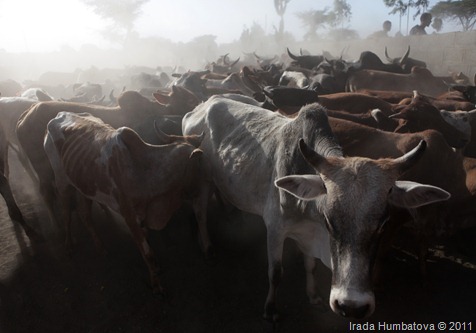
Cows 1

Notoriously known for sleeping in long car rides, I did not even doze off for a second throughout the whole journey. Neither did Irada. We were both constantly fascinated by almost everything, right down to the herds of cattle which seemed to rule the roads in almost every village we passed.

The local cows are shaped rather oddly, with backs protruding like humps and skins sweeping loosely beneath their necks. There was a lot of "Look! Look!" exclamations, as each of us pointed out what seemed to have amused or tickled us from both sides of the car. Jalalem was completely unperturbed, except for his strange fascination for banana plantations as he often pointed out to us.

Despite a lot of frustrations without a local guide, we relied on Jalalem with his limited command of English to explain things. We soon picked up some basic Amharic during the course of our journey.

Since it was already close to the month of June, we began to see the sign of rainy season albeit the seasonal rain being late at this time of the year. The weather was slightly grey and melancholy followed by occasional soft drizzle. There was already flooding in certain lower areas.

Donkeys huddled together under the flat canopy of acacia trees, waiting stubbornly for the rain to stop. I began to notice how endearing these white-snouted four-legged creatures are as I often saw them in pairs, facing each other, as if having a private conversation with only God privy to it. Sometimes, they even nuzzled affectionately against each other’s necks. The sluggish pace of countryside often creates time for love even for animals, as compared to city life where people seem to hurry on with their inconsequential affairs.

While it was unfortunate for the people who were beginning to be affected by the flood, it provided us with some cool respite from the summer heat of Addis Ababa.

Next: Part IV - Getting in sync with nature

Ka Ea used to be a globe trotter. She has lived in Timor Leste and Afghanistan while working as a civic education and human rights officers for the United Nations. She then tried to be a full time housewife in Ethiopia and Cambodia but failed miserably. Now, she works with lawyers and human rights activists by day and watches Discovery Travel & Living by night. She writes for The Malaysian Insider during her dwindling free time. She longs for the day when someone would pay her to travel, eat and write.

Irada Humbatova was born in Azerbaijan’s capital Baku on 12 July 1974. She trained and worked as a midwife from 1994 to 1997, later assisting the International Federation of the Red Cross/Red Crescent with maternal health work by training and supporting traditional birth attendants in rural areas. Since then she has followed her husband on Red Cross missions around the world, developing her love for photography into a passion and profession. Inspired by Africa’s immense beauty and its people’s suffering she moved from art photography to photojournalism. She has since grown to become Reuters’ stringer for Ethiopia and work on assignments for other news outlets and magazines. Irada is currently back in Baku continuing her work with Reuters. She contributes most of the photographs in this series.

Saturday, February 12, 2011

From Loyar Burok: Two Women, Two Tribes and One Journey of a Lifetime [Part II]

Two Women, Two Tribes, and a Journey of a Lifetime is a 9-part series penned by Lim Ka Ea about her one year stint in Addis Ababa, Ethiopia where she accompanied her husband on his 9th humanitarian mission. No stranger to travel and humanitarian missions herself, she learned that Ethiopia is not really Africa and Africa is not really all about national parks or long distance-runners. She also learned that being a "tai-tai" is so overrated unless there is another "tai-tai" to get into mischief with. This 9-parter tells the story of how two "tai-tais" explored Ethiopia and discovered their life as both an individual and a woman. This weekly series started with Part I: My first encounter with Africa

Part II - The faces, sound and smell of Addis Ababa

After two weeks upon arriving in Ethiopia, I soon discovered that I only liked three things about Addis Ababa; its peaceful demeanour, coffee and the mild highland climate, as opposed to the hot blazing sun I had initially anticipated. The city itself lacks the African charm I was expecting although the local residents are amiable enough with their winning smiles, often displaying extremely good oral hygiene.

Many new construction sites are mushrooming all over the city centre despite poor public infrastructure. Many roads are still unpaved and filled with pot holes, large enough to cause pedestrians much discomfort during the rainy season.

Rubber boots

My first purchase in Addis Ababa was a pair of rubber boots although it is easy enough to find pre-pubescent children everywhere, keen to earn a couple of Birrs by cleaning and polishing your shoes to a perfect shine.

It is a city which never seem to leave me alone with constant throngs of children screaming "farenji" (foreigner in Amharic), or "China, China!" at me and the constant battle with the notoriously chaotic road traffic, dominated mainly by what most foreigners refer to as "blue donkeys"; blue and white minibuses and shabby-looking Ladas serving as public transportation. The nickname itself is attributed to the fact that most of these minibuses would often stop anywhere in the middle of the road and stubbornly refuse to budge despite the unprecedented amount of lamentation and honking received from other road users.

Poignant faces of beggars consisting of grubby-looking children, women exposing their wrinkled bosoms unashamedly while nursing their babies, elderly and the disabled, with their arms perpetually extended in hope of charity are a constant sight. For those who have just arrived in Addis Ababa, it is so easy for their hearts to surrender to these psychological assaults but after long period of such regular dosage, even the biggest Samaritan have the propensity to become immune to their plight.

The whole city is used as public latrines as local men are visibly seen releasing themselves shamelessly at every turn of the street, sometimes even right in the middle of a crowd. So, one can only imagine the rancid ammoniac scent of urine emanating the air in many parts of the city. Public littering is another vice to be reckoned with as many private property compounds are used as dumping grounds, with the exception of certain affluent diplomatic residences.

The sound of Addis Ababa stirs as early as four in the morning as devout Orthodox Christians congregate faithfully in churches all over the city. Faint but not inaudible chanting of prayers can be heard from miles away. For those living in Muslim quarters, the soothing voice of the local muezzin singing the azan, calling all believers to fadjr prayer, slowly breaks the silence of dawn.

For those who are still in bed by seven, shouts from street peddlers selling basic household items such as broom sticks, brushes and other basic household knick-knacks are sure to induce a couple of disgruntled curses, often spoiling the start of one’s morning before that hot aromatic cup of Harari coffee.

Ethiopians do like their fair share of loud music with radios belting local pop songs by Ephrem Tamiru and Teddy Afro, African-American hip-hop, reggae and rhythm and blues from grocery kiosks, coffee bars, cars and taxis. If it is not the loud music, a full blown orchestra played by hundreds of Sesame Street Honkers poltergeists along Bole Road, often referred to as the Champs Elysees Avenue of Ethiopia, receives standing ovations every single day.

Despite its fairly religious society, young urbanites are relatively open about their sexuality. The city hosts several nightclubs known for its seedy sex industry frequented by many foreigners. As a woman, I never cease to be amused by the indiscretion of local men giving persistent glances and flirtatious signals everywhere I go. Local women apparently extend the same courtesy to members of the opposite sex although in a slightly more subtle way.

In the beginning, I took it as a form of flattery which eventually turned into a liability as it became more difficult for me to enjoy my cup of coffee without feeling that I was being mentally stripped. However, with the right amount of distance and ignorance, most men often left me alone as soon as they ascertained my level of indifference.

On the opposite side of the spectrum, I found many women in Addis Ababa showing complete apathy and sometimes even hostility towards me for reasons which remain a mystery at large.

Desperate housewife

After several failed attempts to find a job in Ethiopia, I found myself falling slowly into a rut as I struggled to adjust to a new lifestyle. I began to spend a lot of time on my own as I could not find anything in common with other women whom I have met along the way. After working in challenging contexts in Timor Leste and Afghanistan, I was soon consumed with boredom, demotivation and above all, gradual deterioration of my own self esteem as I attended to daily chores of a more domestic nature.

In order to combat my boredom, I volunteered for the Ethiopian Red Cross although it lasted for five months only. As a volunteer, I was not satisfied with just the sense of altruism it created. I wanted to have a bigger role, to be part of the decision-making process, something which I was often used to while working for the United Nations in Timor Leste and Afghanistan.

The recent regular power cut imposed by the local authority in its feeble attempt to save energy three times a week in the city has further aggravated my irritation.

I tried to occupy my time by learning French, writing and improving my cooking skill, much to my husband’s dismay due to the often unpalatable results. I would sometimes go to nearby cafes to enjoy brunch with my beloved cup of strong black coffee while reading a book but most visits tend to end up with harrowing experiences of finding strands of coarse and curly human hair staring rudely at me from my food. All these perfunctory activities made me felt empty and completely dispirited.

In conclusion, I developed a progressive dislike towards Ethiopia, fed mostly by my own injured spirit. I thought that for the first time in my life, I would leave a country filled with a lot of bitterness and worst of all, with nothing to gain at a personal level.

Next: Part III - The gift of a kindred spirit

Ka Ea used to be a globe trotter. She has lived in Timor Leste and Afghanistan while working as a civic education and human rights officers for the United Nations. She then tried to be a full time housewife in Ethiopia and Cambodia but failed miserably. Now, she works with lawyers and human rights activists by day and watches Discovery Travel & Living by night. She writes for The Malaysian Insider during her dwindling free time. She longs for the day when someone would pay her to travel, eat and write.

Irada Humbatova was born in Azerbaijan’s capital Baku on 12 July 1974. She trained and worked as a midwife from 1994 to 1997, later assisting the International Federation of the Red Cross/Red Crescent with maternal health work by training and supporting traditional birth attendants in rural areas. Since then she has followed her husband on Red Cross missions around the world, developing her love for photography into a passion and profession. Inspired by Africa’s immense beauty and its people’s suffering she moved from art photography to photojournalism. She has since grown to become Reuters’ stringer for Ethiopia and work on assignments for other news outlets and magazines. Irada is currently back in Baku continuing her work with Reuters. She contributes most of the photographs in this series.

Thursday, January 20, 2011

From Loyar Burok: Two Women, Two Tribes and a Journey of a Lifetime [Part I]

I’ve recently submitted a series of essays on my trip to South Omo Valley a couple of years ago to Loyar Burok. I’m reposting them here.

Two Women, Two Tribes, and a Journey of a Lifetime is a 9-part series penned by Lim Ka Ea about her one year stint in Addis Ababa, Ethiopia where she accompanied her husband on his 9th humanitarian mission. No stranger to travel and humanitarian missions herself, she learned that Ethiopia is not really Africa and Africa is not really all about national parks or long distance-runners. She also learned that being a "tai-tai" is so overrated unless there is another "tai-tai" to get into mischief with. This 9-parter tells the story of how two "tai-tais" explored Ethiopia and discovered their life as both an individual and a woman. It begins with Part I: My first encounter with Africa.

Hamer woman

Part I: My first encounter with Africa.

More than three years ago, I was asked to pack my bags and relocate to Addis Ababa. I was to accompany my husband who had then received a job posting with an international humanitarian organisation in Ethiopia. I remember feeling elated but above all, I was filled with such great expectations. It was the first time I was to set foot in East Africa, a land which has inspired great explorers, writers, photographers, artists, movie makers and environmentalists. It is also a land which inspired me since I was a little girl.

For the first time after three years since Afghanistan, my soul was stirred yet again as I prepared to travel to another unknown world, one which I could previously see only on television screens or read from paperbacks. My mind took me to places where the legendary Dian Fossey once made the first ever recorded peaceful human contact with the mountain gorillas of Rwanda and the mystical peace and tranquility of Mount Kilimanjaro as described so vividly by Hemingway.

I remember sighing with sheer pleasure and awe as I watched the breathtaking cinematography of Sydney Pollack in Out of Africa where Karen Blixen made her unforgettable journey on air over the Ngong Hills to Mombasa. She had apparently said, "Yes, I see. This is the way it was intended." And now, it was my turn to see how it was intended to be.

I couldn’t help but dwell in mental images of ubiquitous savannah where herds of African elephants with their magnificent ears, marching gracefully in a single file and zebras, each with their uniquely patented stripes, grazing under the watchful gaze of mighty predators. I even fantasised about hopping up and down with the Masai Mara, as seen in "your local bank" advertisement.

Such was my impression of Africa.

Mursi boy

Unfortunately, I was quick to learn that Ethiopia is unlike many of its African neighbours. For many people who bear very little knowledge of this country, nestled in the Horn of Africa, it is probably best known for three things; the great famine during the 1980s, middle distance and marathon runners and the discovery of Lucy, the oldest bipedal human species to walk the world 3.2 million years ago. That was the little knowledge I had brought with me to Ethiopia.

I soon understand that Ethiopia, formerly known as Abyssinia, is rather unique in terms of its socio-cultural practices, which sets her apart from her other African sisters. I began to comprehend what the locals meant when they adamantly insisted that Ethiopia is not Africa, in which I had often responded with a sinister look.

Now, I am willing to accept that what would make Ethiopia "African" is purely geographical in nature, just like Egypt, Tunisia and Morocco.

The Millennia in Abyssinia

Ethiopians are the only people in the world who speak Amharic, a Semitic language influenced by Arabic, Hebrew and Assyrian. It is also one of the two countries in the world which adopts the Coptic Calendar, inherited from ancient Egyptians. This means, instead of twelve months in a year, it has thirteen, which aptly explains why its tourism board has adopted the slogan "Thirteen Months of Sunshine."

Needless to say, it also means that Ethiopian calendar is seven and a half years behind our commonly used Gregorian calendar. The millennium was celebrated with much pomp and circumstance in 2007 as Ethiopians ushered in the twenty-first century, albeit the huge global Y2K hullabaloo seven years ago.

Learning to tell the local time is also a practise in need of getting used to. For example, according to Ethiopian time, it is six hours behind our ordinary comprehension of time, which often generates confusion to the unfamiliar when making appointments with the locals. This is due to the fact that while we start our morning at 6a.m. they start theirs at 12p.m. So if the plumber agrees to repair your clogged toilet first thing in the morning at two o’clock, do not get into a fury because it only means eight in the morning!

The pride of Ethiopia

Ethiopians are essentially proud people, mainly rooted in the fact that it is the only African country that has defied foreign colonialism. It is also a country that is steeped in its own history, civilisation, legend, tradition and culture. Whether some of the mystical legends bear any truth to it, they still serve as a unique source of national pride, both filled with charm and intrigue.

History has revealed that in 400BC, there was an ancient great civilisation called the Aksumite Kingdom situated in the north of Ethiopia. Once a powerful empire, having stronghold on the commercial crossroad of the Red Sea, it rose to great prosperity and fame from international trade with Egypt, Syria, Italy and India.

Local legend has it that Aksum was once Queen of Sheba’s capital in the 1000BC. It also believes that Emperor Menelik, whose dynasty would eventually reign in Ethiopia for the next 3,000 years, was the son of King Solomon, conceived with Queen of Sheba on her visit to Israel.

Menelik, then returned to Jerusalem to visit his father, had stolen the Ark of the Covenant to be returned to Ethiopia. It is believed that the Ark of the Covenant now sits in Aksum’s St. Mary of Zion church. Although visitors are forbidden to sneak a peek at the covenant, many faithful Ethiopians continue to believe its existence today.

Ethiopian Coffee Ceremony

While we could never truly unravel the legitimacy of this legend for now, we do however know that coffee originated from Ethiopia which holds very good reason why coffee ceremonies are held in such high esteem here. I, for one, have stopped drinking instant coffee ever since I had my first cup of Ethiopian coffee. It is really the best!

In terms of nature and wildlife, Kenya and Tanzania may be the preferred destinations for safari and national parks; Ethiopia is an ornithologist’s dream as it is the habitat of eight out of ten endemic birds of Africa. It is also the home to the endemic Gelada Baboon, Ethiopian wolf, and the Mountain Nyala.

The other aspect of Ethiopia’s uniqueness is the Ethiopians themselves. Ethiopian beauty is no stranger to many people especially those who are fashion savvy. Gracing the covers of many top fashion magazines and Paris and New York haute couture catwalks is Ethiopian supermodel Liya Kebede and she is not the only Ethiopian woman blessed with such good looks, bone structure and physique. Ethiopians do have a different genetic makeup from the rest of Africa, with the exception of some Eastern African countries like Somalia and Sudan. They have lighter skin tones, higher cheek bones, finer facial features and often lanky.

This does not mean that Ethiopian women take their looks for granted. In Addis Ababa itself, it is easy to spot hair and beauty parlours even in the most remote of alleys where local women sit religiously for hours maintaining or changing their often intricate hairstyles on a weekly basis.

Next week: Part II - The faces, sound and smell of Addis Ababa and how a second tai-tai with her photo camera and assortment of lens come into the picture.

Ka Ea used to be a globe trotter. She has lived in Timor Leste and Afghanistan while working as a civic education and human rights officers for the United Nations. She then tried to be a full time housewife in Ethiopia and Cambodia but failed miserably. Now, she works with lawyers and human rights activists by day and watches Discovery Travel & Living by night. She writes for The Malaysian Insider during her dwindling free time. She longs for the day when someone would pay her to travel, eat and write.

Irada Humbatova was born in Azerbaijan’s capital Baku on 12 July 1974. She trained and worked as a midwife from 1994 to 1997, later assisting the International Federation of the Red Cross/Red Crescent with maternal health work by training and supporting traditional birth attendants in rural areas. Since then she has followed her husband on Red Cross missions around the world, developing her love for photography into a passion and profession. Inspired by Africa’s immense beauty and its people’s suffering she moved from art photography to photojournalism. She has since grown to become Reuters’ stringer for Ethiopia and work on assignments for other news outlets and magazines. Irada is currently back in Baku continuing her work with Reuters.