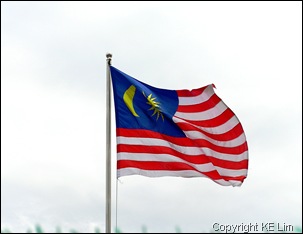
I wrote this short fiction awhile ago. It was my vision of Malaysia and thought it might be appropriate for today as we celebrate the 52nd anniversary of our Independence Day. Although many incidents had happened in the past few weeks that had hurt some members of our communities, I am still hopeful that things will change for the better.
This is for all Malaysian who wants to see a OneMalaysians rather than OneMalaysia.
*************************************************************************************************************************
`Malaysia BOLEH Cari Makan’ hosted by PPP a.k.a Puthu Piring Pandan
As a child, Muthusamy son of Doraisamy had many dreams. He dreamed that one day he would no longer be ridiculed for his name, the colour of his skin, the innate tilting motion of his head from side to side and accent when he speaks, his likes and dislikes. When he became an adult, he would only have one dream and that would be for the day when his parents would finally stop nagging him about how he would never become a successful man (and by successful, they meant a doctor, lawyer or engineer, which according to them were the holy trinity of all professions).
And so, Muthu developed the only friendship he ever had with a boy named Salim bin Abu Bakar, who one might say, is the only person who truly understands him.
The last time Salim saw Muthu was five years ago. Muthu was unashamedly dressed in an ill-fitting white V-neck t-shirt, which bore three identical fluorescent orange letters that seemed to scream out PPP! Both sleeves had been cut out at the shoulders exposing faded-looking indigenous patterned tattoos on his meaty biceps. The fake tattoos were courtesy of a recent trip he made to Sarawak. The XL sized t-shirt did nothing to conceal his protruding belly, a proud gift from two years of fine dining, according to Muthu’s own standard.
The sight of Muthu’s thick, coarse and curly hair, peeking obscenely at his chest level would have been an eyesore to any self-respecting men and prudish-upbringing women. But instead of repulsive looks being thrown at him, he received gazes of immense respect and awe by those within the parameter of his imposing figure.
That was the Muthu whom Salim knew for more than twenty years before he packed his bags abruptly and relocated his whole family to London. What was initially a two-year work stint turned into five when Salim’s wife became pregnant with their second child. This had all contributed to his extended sojourn in a foreign land.
Salim remembered his parting words to Muthu over their usual late night roti canai and teh tarik at Lingam’s Corner in Taman Tun Dr. Ismail. “I hope PPP finds what he’s looking for,” to which Muthu responded with a shrug and a goofy smile.
To Salim, Muthu was a decent enough kind of guy. The kind who would not go through arm’s length to help someone but neither would he harbour malicious thoughts against another. It wasn’t so much as he had no malice in his soul, he just couldn’t be bothered. Muthu was the kind of guy who wouldn’t necessarily devote himself to charitable work but would help a blind person cross a street, only because he thought it was the right thing to do and no one would find out about this as he was also the sort who would never advertise what others would consider as benevolence.
There was nothing really special about Muthu in terms of being a student. He didn’t excel in anything in school, he was the average kind of student who sat quietly in class, did his homework satisfactorily and would never bother to disturb the girls. In fact, come to think about it, Salim had never seen Muthu expressing any interest in girls when the rest of the boys would put on either their best or worst behaviour just to get their attention. Muthu did not have much opinion about anything even to the point of avoiding any potential need to express an opinion. So, Muthu was a complete misfit in that sense, much to the annoyance of those who were unable to figure him out.
Once, Salim with a group of boys gathered in an otherwise empty classroom during recess time to chat about whom they thought was the prettiest girl in class.
“Oohhh…no way, man. No-lah, I tell you, I think nobody can beat Carol. She looks shy only but I’m sure she would like to be kissed,” Ti Chong said with a bit too much gusto as he puckered up his lips and like a freak gold fish that squeals like a rat, released a shrill and obscene kissing sound, those often made by sociopathic boys on the street to gain the attention of virginal-looking maidens in flower patterned head veils.
“Oi, Chong! We’re talking about who’s the prettiest-lah. Not who’s the sluttiest. Aiyoh….this guy damn hamsap, man!” Salleh pretended to chastise them as soon as he caught the disgusted but curious glances of two Chinese girls with identical haircuts, brown hairclips and brand new turquoise pinafores, presumably Form Three girls whose parents decided that they should start to learn Bahasa Malaysia properly if they were to qualify for Form Six.
Ti Chong turned to look at Muthu and asked, “Eh Muthu Keling! What you think, huh? Carol pretty or not?” If Muthu’s skin was several shades fairer, he wouldn’t have been able to disguise his embarassment and discomfort, being confronted with a question like that. Instead, he barely answered Ti Chong, stood up and left the room looking neither perturbed nor interested in the outcome of the ensuing discussion. His departure was followed by a cacophony of Muthu Keling is a pondan, Muthu Keling likes boy, Muthu Keling is this and Muthu Keling is that. Salim never thought that for someone who was as unremarkable as Muthu could be so many nasty things at one time but still, he kept his mouth shut. Like Muthu, he preferred not to voice an opinion in such situation.
Salim never ceased to be amazed by how Muthu tolerated all those childish indiscretion committed by their fellow classmates. Being labelled with a double derogatory names like keling and pondan must be no doubt damaging to one’s self-esteem but surprisingly, Muthu never allowed any of it to disparage him and in fact, he just couldn’t be bothered like the many other things in his life. That might have been the reason why Salim became close to Muthu, not for the latter’s indifference but self-preservation instead.
To say that Muthu was completely devoid of any interest in life was untrue for he did have a passion for one thing. While the other boys longed for extended sessions of Physical Exercise so that they could kick-ball instead of pretending to know-all, Muthu secretly wished that he could join the Home Economics class and for the rest of his teenage years, he would also secretly continue to curse the education system’s discrimination against his gender.
Whatever the other boys knew about football, computer games and comic books, Muthu replaced them with his then rudimentary knowledge of food, cooking TV programmes and recipe books. Maradona was who all the other boys aspired to be, but for Muthu, Chef Wan was his idol. When the boys discussed about how the amazing Spider-Man rescued Mary Jane from the evil clutches of the Hobgoblin, Muthu mentally visualized Chef Wan pouring coconut cream on sago pudding.
During recess time, when all the students jumped up from their seats to thank their teachers in unison and rushed off to the canteen to beat the queue, Muthu would bring out his often two but sometimes three-tiered stainless steel tiffin filled with all sorts of tantalizing scent of cardamom, cloves, lemon grass, kaffir lime leaves, turmeric and the occasional pungent and fishy smell of fried ikan bilis. The symphony of smell was enough to make anyone within two feet salivated and cursed Muthu for having a mother who chose to prepare intricate lunch boxes over gossiping with their next door neighbours while collecting the early morning newspaper.
Although most kids tried to disguise their jealousy by making a mockery out of this, “So what time Mummy had to wake up this morning to pack your stylo-mylo lunch box, huh? Muthu Keling? Or did you cook them yourself? You pondan, mah?” Muthu ignored them and Salim had to admit that Muthu’s nonchalance was a shrewd tactic because at the end of the day, who were the losers? The rest of them who had to settle for the unpalatable and often inedible stale karipap and cucur udang at the school canteen or Muthu who savoured the mouth-watering and wholesome sustenance of Mrs. Doraisamy’s expression of love for her only child?
Salim believes that this quest of Muthu’s is perhaps the main thing which has connected them for all the time that he was away. It is that “constant” in their friendship. They may have grown apart in many ways, but there have been many times when Salim wonders about Muthu’s unfulfilled dream. You see, Muthu had a certain innocuous obsession which many found peculiar, but that was just being Muthu and nobody could understand that but Salim.
For all the time that Salim has known Muthu, he had never once seen him eating anything else but Malaysian food. Forget about treating him to a succulent piece of chargrilled rib-eye steak in an expensive restaurant because he would insist that he was “just-not-so” into Western cuisine. (His “just-not-so” was a complete understatement because Muthu would never contemplate shoving anything that wasn’t laksa, char kuey teow, nasi lemak, roti canai, rojak or anything un-Malaysian, as he would always call it with an added hint of scorn, down his throat.)
Muthu also firmly believed that whatever is expensive does not necessarily translate to being good and therefore, Malaysian cuisine makes perfectly great food in terms of value for money. Muthu did however, make the exception for what he would call “MM” short for Malaysian Mongrel food in reference to the gastronomic fusion of local flavours and those from other countries in Asia, savoured by all Malaysians.
Muthu eventually began to receive less and less invitation to dine. His refusal to flirt with un-Malaysian food was met with much consternation by others. Their friends decided that they could no longer tolerate or accommodate his irrational prejudice. According to them, Muthu was even worse than a Malay. His self-imposed dietary prohibition wasn’t targeted at pork alone but also anything else short of the standard Malaysian appetite for chillies, belacan, Indian spices, coconut cream and pandan-flavoured sweets. At least in Malaysia, Malays like Salim still enjoy halal McDonald’s, KFC and Pizza Hut.
As for Salim, Muthu remained as a faithful dining companion because he would always make an effort to choose Western-Asian restaurants that are widely available in Kuala Lumpur to accommodate Muthu and his own occasional cravings for lamb shanks and T-bone steaks. They had spent a significant amount of time travelling around the country filling their stomachs with local fares and one must admit that the choices of Malaysian food is truly abundant, if not endless.
Salim’s friends often wondered how he, as a Muslim, was able to cope with Muthu’s demand for authentic local food. Even as a child, Salim remembers how his own family had subjected him to a lot of grief when it came to eating food which was prepared using “unclean” utensils. When he was invited for lunch at Muthu’s house, his father would go on a long lecture on how his son’s iman would be tainted should the latter partake in any food prepared by those who did not share the same faith. No matter how hard he argued, his father insisted that Glo dish washing liquid would not cleanse what was already spiritually impure to begin with.
In order to appease both father and son, Puan Rokiah would pack her son’s lunch in plastic Tupperware with a pair of metal spoon and fork for safe measure. While it seemed like a fair compromise, Salim could not imagine the humiliation he would cause the Doraisamy household if he were to refuse their food and adding salt to injury, brought out his own lunch boxes. It would be like telling Muthu right to his face that although he accepted his kind invitation, he wouldn’t want to risk having diarrhoea from Mrs. Doraisamy’s cooking.
So, Salim never told his parents how he emptied the content of his lunch box after he had his fill of chapati, dhal curry, aloo gobi and resam, at the back alley of Muthu’s house much to the local stray cats’ delight. In a triumphant note, he would later announce to his father that he didn’t even allow Mrs. Doraisamy to clean the Tupperware but Puan Rokiah would always wonder why the cutleries had remained spotless.
Muthu once asked Salim whether he had ever wondered how pork taste like over a conversation on a recent scandal about some restaurants being shut down on suspicions of operating under the falsification of halal licensing in Ulu Bernam.
“Well, does it taste like beef bacon and turkey ham?” Muthu burst out laughing and while wiping the tears that had begun to trickle down from the corners of his eyes, he said, “Let me ask you something, Salim. Do you think that those char siew made from tofu tastes anything like the real thing?”
Salim stared at Muthu incredulously, expecting him to realise that he wouldn’t know since he has never tasted barbecued pork before.
“I-say-man, how would you know?” Muthu said with a chuckle upon the realization of his own folly and then paused to ponder for awhile. He creased his nose several times the same way he always did in school when cornered into answering questions in class, which probably explained those permanent horizontal lines imprinted on the bridge of his nose. For anyone who didn’t know him better, they would have thought that Muthu spent all his childhood making offensive piggy faces at other children and as punishment, will always wear this facial flaw on him.
“Hmm…ok, ok. Like this,” Muthu said. “Do you think that vegetarian rendang taste anything like your mother’s rendang?” Salim looked at him, thought for awhile and realised that he has never tasted vegetarian rendang either, but he got Muthu’s point and so he shook his head.
“Same thing, brother. All this beef bacon nonsense, you cannot compare with real bacon! They are even worse than MM, I tell you. They are what I would call CDPC, Cows-Dressed in-Pigs’-Clothing!” Muthu declared scornfully and then laughed at his own joke. Salim would have laughed too if he wasn’t alarmed by his friend’s ridicule and low impression of halal pork.
“No need to look so worried-lah, Salim. I know you’re a Muslim and I respect your religion and the way you stick to it,” Muthu said. “I think nobody can understand this better than me. What difference does it make that you don’t eat pork and me with all this rubbish Mat Salleh food? You respect my taste, I respect yours. Simple as that!”
Comforted by his statement, Salim seized the opportunity to ask Muthu what he had against non-Malaysian food. “Salim, I’m a keling, as some people like to call me but I don’t know anything about India and being an Indian. And I’ll tell you straight, brother. I-don’t-care. I am Malaysian. But you see-huh, you and I are different.”
Salim retorted, “What do you mean by we are different?” slightly worried that Muthu would embark in a debate about how racist he thought the Malays were.
“Relak-lah, brother. What I’m saying is, you have an established identity already and me? I’m still finding mine. I find that food seems to unite us all Malaysians. It’s enough that we have the chinese, malays, indians, mamaks, chindians, nyonya and babas and all this not including what we have in Sabah and Sarawak. Right or not?” Salim nodded his head in agreement.
“I tell you, who needs these blardy Italians, French, Japanese and all the other rubbish to compensate for our already rich flavour,” Muthu continued. “You go to a mamak stall at 2 o’clock in the morning and what you see, huh? Tell me what you see, Salim.”
Without waiting for Salim’s reply, Muthu went on with his merdeka speech. “You see all these flers. Kopi susu-lah, horlicks-lah, kopi-o, whatever-lah! enjoying roti canai and teh tarik. To me, that is what Malaysia stands for. I don’t care about the politics, racial sentiments and all the other nonsense. But food, ahhhh….that is different altogether!” Muthu paused for a split second to catch his breath before he continued, “And that, Salim, is the identity I am proud of and will defend to my death. Right or not?”
Salim swore that if their founding father, Tunku Abdul Rahman was still alive, he would have adopted Muthu straight away and if they were both twenty years younger, they would have been selected by Petronas for this conversation to appear in one of those touching once-a-year Yasmin Ahmad National Day advertisements on Astro channels. Ti Chong however, would have to be included for best measure.
Salim had to confess that the conversation reinforced their understanding for each other. If anything, before they were like new lovebirds about to enter into one of those steady relationship conundrums where both are unsure if it’s still too early to ask how many babies they like to have once they are married. If you ask too soon, it might give the other the impression that you’re already planning in advance for a lifetime together and the next thing you know, the phone calls stop and you curse yourself for taking that leap pre-maturely and not to mention unilaterally. Often than not, you are simply too afraid to hear anything which might disappoint you. However, if you don’t ask, you might end up wasting your life committing to someone who doesn’t share the same ideals.
While being completely aware of their differences in cultural and religious upbringing, neither Salim nor Muthu had the courage before to speak about their fears and what could have unwillingly jeopardized the friendship they have.
Soon enough, their food expeditions became a regular affair and what would have been previously off-limit, Muthu now took Salim to hawker stalls and night markets where both take-outs of non-halal and halal food were available within close proximity. Sometimes, Salim would queue with Muthu while the latter waited for his turn to take his order and in the beginning, Salim was uncomfortable with the curious stares of the Ah Kows and Thambys standing next in line. Their looks however, were not as hostile as the Ahmads and Tambichiks standing across the next stall waiting for their murtabaks.
There were many times when Salim was tempted to dispel their silent pre-conceived judgment of him by asking cheekily, “See only, mah. Cannot, meh?” but as time passed by, he managed to reason with himself that he hasn’t done anything against his religion. If anything, didn’t the Quran said that God has created them from the same male and female and given them distinct people and tribes so that they may recognize one another? What he did was simply recognizing Muthu’s “tribes”.
One of the things that Salim liked about eating with Muthu was the anticipation while waiting for their food to arrive. Ironically enough, Salim thought that Muthu, who had never given his time of the day to girls, would have been a great lover if he applied the same method of foreplay he used to describe food. Muthu had the ability to tantalize the thalamus and occipital lobe with his slow and yet attentive commentaries, often paying careful and yet enthusiastic attention to special details like the smell, taste and texture right down to the sound of the first bite. All this did nothing but contribute to slowly building up Salim’s appetite which gradually turned into an explosive crescendo of flavour when he finally sampled the food, which, to Muthu’s credit often turned out as good as his choice of words. To Salim, Muthu was the reincarnation of Martha Stewart meets Steve Irvine.
Once, they stood in a long queue at a char kuey teow stall in Lorong Selamat, Penang. Muthu, as excited as a kitten captivated by a moving object, chattered all the way through the queue about the benefits of frying the long thick strands of white translucent rice noodles with hot burning charcoal instead of a gas ignited flame. If he had a tail, it would have wagged at the speed of a hummingbird.
As if he, himself were the fisherman responsible for the prawns, he could not stop bragging about how big and succulent the prawns were compared to other stalls that often parsimoniously pinched on essential ingredients like prawns and deep fried pieces of pork lards. He also insisted that the cockles used in this particular stall were among the freshest judging from the bloody dark reddish brown liquid that seemed to hold them together in a huge plastic bucket, when accidentally shaken would cause the contents to tremble like cellulites on flabby arms. Salim imagined that the freshness could only be matched by its strong taste and smell of ferrum. According to Muthu, any vampire who took the pledge against cannibalism would be happy to find an alternative here.
One weekend, they managed to purchase one of those ridiculously cheap Air Asia flights to Sarawak. Salim was looking forward to visit the Santubong Fishing Village and the turtle sanctuary of Satang Island. Muthu of course had other plans for them. He insisted on going to the Annah Rais Longhouse Village to see what the Bidayuhs eat (in other words, he would like to actively partake in the eating process rather than just being a passive witness on the side). Salim might as well count his blessing just in case Muthu decided that turtle eggs were better used as food ingredient than to preserve the specie.
On their last day, Salim and Muthu spent the entire afternoon searching for the best Sarawak laksa in Satok. If Muthu had a choice, he would have brought a couple of them back with him to Kuala Lumpur. Unfortunately, he could not fashion a way to pack them securely without any risk of spilling the spicy and fragrant soup, something which would have been a disaster of an apocalyptic proportion to him.
One day about seven years ago, while Muthu was googling for more local places to eat, he came across a random comment made by someone in a food forum which unfortunately insulted him to an unimaginable proportion. If a computer can be programmed to carry out human bodily functions, it might as well spit on his face. As he sat there staring at those seven words, “Malaysia doesn’t really have a national food,” he was filled with tremendous despair, much more than the time when Mr. Doraisamy had declared to the whole world that he was a gundu-good-for-nothing son, the kind who had failed to live up to their parents’ dreams. Not only had he failed to secure any of the three sacred jobs considered worthy by his parents, he did not qualify for Form Six and hence, ended up as a salesman for a second-hand car dealership company.
“Yes, yes…nowadays we cannot force our children to do anything. Unlike your son Rajen who is now a big shot doctor, our Muthu is a gundu-good-for-nothing-son,” Mr. Doraisamy sighed for a brief moment before he continued hastily,”We have given him everything but see what happened? During our time, it was different. Right or not? Where got their appapa give us everything? But we continue to work hard so that we can give them everything. Right or not?” Muthu overheard what his father said to some relatives who were visiting from England one night while he was untying his shoe laces outside the door.
“Aaahhh…but we always tell our Muthu. No space for Indians in Form Six never mind! Appa got enough money to send you to India to study but what did he say to us?!” Mr. Doraisamy lamented, followed by another sigh. That night, Muthu laid on his bed and like a remote control, he turned off the power switch to his brain and started dreaming.
But now, the sheer thought of how he had preserved his eating lifestyle and food culture at the expense of friendships and possibly a normal relationship with any women, often even more fanatical than a Taliban, was more than Muthu could swallow. He never once considered the fact that none of these local dishes actually represent all the ethnic races in Malaysia, and hence cannot really seek to claim the coveted title of national food.
In his moment of anguish, he realised that he had found his calling. He must try to invalidate that wretched random-whoever-it-was-who-until-now-did-not-exist-to-ruin-his-life’s opinion, at all cost.
Over the next few months, nobody knew what Muthu had up his sleeves but Salim knew something was amiss. Muthu’s sudden disappearance from his life created such a vacuum that he began to fill his mind with all sorts of sinister thoughts, especially when Muthu refused his invitation to a new Indian restaurant in Bangsar South. The fear of Muthu abandoning him in one of his eating sprees did come across Salim’s mind. Or worse, perhaps Muthu had found a new dining companion who wasn’t Malay but another thamby who could share thoughts over a glass of beer and bona fide bacon, not CDPC, an acronym he invented once as a disparagement.
After about three weeks, Muthu’s phone call never came. Instead, he had simply turned up at Salim’s front door looking like the cat that has swallowed a canary.
Muthu told Salim that by a stroke of good fortune and his persistent display of strong conviction, he managed to convince someone who knows someone at the Asian Food Channel to produce a food programme called Malaysia BOLEH Cari Makan, loosely translated as ‘Malaysia CAN look for food’ and it would be hosted by none other, but him. And so, Muthu Keling Pondan became Puthu Piring Pandan, a name picked deliberately as an overt extended-middle-finger to those who remembered him as the effeminate-dark-skinned-Indian.
The show helped transformed Muthu completely. From an unopinionated person, he suddenly became the most opinionated person on TV. Malaysia BOLEH Cari Makan was a catharsis for Muthu. Like an unwanted morsel of bread crust tossed away on the floor without as much of an afterthought and attracting thousands of ants in a matter of minutes, Muthu became an overnight icon, loved by many Malaysians, partly due to the “romantic” idea that finally an ethnic minority Indian had publicly expressed his love for his country by his own volition, even if it was through his stomach that had grown in proportion with his new found fame.
Malaysia BOLEH Cari Makan became known as a cook show with an ooommpphhh, generating a wide demographic range of local audiences. It owed much of its success to Muthu’s innovative approach based on the concept of audience participation. The producers might have been the ones to ensure the funding and execution of the show, Muthu was certainly the creative mind behind it.
In each episode, Muthu selected two local dishes to compete with each other. He would then visit different restaurants, food courts, hawker stalls and sometimes even catering companies all across Malaysia famed for the selected dishes. At the end, there would be two short low-budgeted but nevertheless witty music videos featuring the competing dishes and Malaysia would vote which of these dishes deserved to be crowned as the ultimate national food. The winning dish of each episode would then compete with each other to become Malaysia’s National Food in the final season.
Muthu tried his best to target different demographics by reserving the more conservative story lines to older generations and then something more edgy for the younger ones.
Once, he tried to propose a video clip in conjunction with Valentine’s Day which would have set off a precedent with its underlying sexually provocative tone. What would have been called the Venus de Mil’O-Chian video, featuring a woman climaxing to a song describing the aphrodisiac properties of the fried oyster omelette (incidentally, was also the competing dish) to the music of Barry White’s You’re the First, the Last, My Everything, didn’t make it to the TV screen. The show’s very own censorship adviser decided that the idea was too close to pornography for the ultra-conservative members of the public, which unfortunately, were also the majority of the population. It might as well didn’t make the cut because it would have been easy for the casting crew to find a large Indian man resembling Barry White to be featured alongside the woman, but nobody knew whether the man could have carried out the vocals as convincingly.
The personal downside of the show for Muthu was that during the course of his food tour, he learned a lot about the origins of his subject matter. And truth be told, he finally understood what that random-person-who-ruined-his-life-once-upon-a-time-ago meant.
Through the process of pork elimination, anything not halal can never be regarded as Malaysian. The Nyonya food which every Malaysian knows comes from a specific community called the peranakan is a mixed between the Chinese and Malays at the straits settlement or modern day Singapore, Malacca and Penang during the British colonial period . All those lovely roti tissue, roti pisang, Maggi mee goreng from the ubiquitous mamak stalls which have become an essential after-dark melting pot of local culture, can never be truly Malaysian for isn’t mamak essentially means Indian Muslims?
On the very night when Malaysia voted by a huge margin to declare nasi lemak as the national food over char kuey teow, he celebrated the end of the TV season by googling nasi lemak in the privacy of his home. The first search answer popped out as “a famous breakfast dish of Malay origin”.
That was the last news Salim has on Muthu’s career as PPP. And so, in the wink of an eye, half a decade has flown by and Salim is sitting at what is now one of PPP’s chains of restaurants expecting Muthu to walk in through the folded wooden-panelled door at any time. Sitting at the exact same spot five years later, Salim wonders whether Muthu will look and behave exactly the same, with his prosperous paunch and signature apathetic attitude towards most things in his life.
As Salim looks around him, he discovers that the crowd is much bigger than when it was Lingam’s Corner. He can’t help but stare at the waiters’ white t-shirts that have the same fluorescent orange letters, those three identical letters, no more and no less and yet it carries with it all the dreams and aspirations which can only be fully understood by its owner and himself.
When Salim sees an Indian waiter speaking to his Chinese colleague who is then interrupted by another Malay waiter, he soon realises that it isn’t just the name of the restaurant that has changed. Muthu has cleverly and not to mention successfully created a whole new concept of local food culture. This is a restaurant which has incorporated the elements and spirit of mamak stalls, Chinese kopitiam and Malay warung under one roof, serving all the main local food, loved best by Malaysians. Muthu had personally handpicked the ten winning dishes which made it to the final season of his show, with the addition of the puthu piring, preserved as its specialty in honour of the restaurant’s namesake.
Salim has read about PPP’s success on the Lonely Planet guidebook about Malaysia. Imprinted on the page, it says, “Although local restaurants can be found anywhere in Malaysia, to have an unforgettable gastronomic experience on all the three major culture in one sitting, one must absolutely make a stop at PPP in Kuala Lumpur. And if you’re lucky, you may even catch a glimpse of Malaysia’s most fascinating and beloved icon, Puthu Piring Pandan, the proud owner of this chain of restaurants which have created a storm across South East Asia, up to Hong Kong and even India.”
Salim feels a sudden rush of pride overcoming him. He would never have imagined the proportion of Muthu’s success within five years, especially knowing how Muthu was an unremarkable boy who was taunted mercilessly by his peers and being looked down by his own family.
As soon as he thinks he sees Mrs. Doraisamy beaming at the cash counter, he hears a round of loud cheer coming from the front of the restaurant. Salim tries to scan through the crowd of diners who have begun to stand up, blocking his view and chanting PPP, Hooray! PPP, Boleh!
Salim tries to get a good look at the smiling man who is responsible for all the ruckus, who by now is moving slowly through the crowd and as if expecting someone, he looks around the restaurant. Once the man sets his eyes on Salim, he rushes towards him.
It takes Salim about a split second to realise that the man is Muthu but what he hasn’t expected is that half of the Muthu he knew has somehow disappeared. Standing before him is a younger, thinner, happier and better looking man. If not for the goofy grin and those permanent lines on the bridge of his nose (even more visible now since Muthu’s complexion has cleared up considerably), Salim will never have guessed. Of course, the biggest give-away is still the thunderous applause generated by presumably loyal customers and tourists who come in every night hoping to catch a glimpse of him.
Salim leaps from his seat and as if he was a long lost twin, Muthu gives him a lingering bear hug. Muthu’s warm welcome and public display of affection by now has made him an object of public curiosity.
As soon as Muthu releases him, he pulls a step backward and with both arms on Salim’s shoulders, looks at him from head to toe, as if to check whether he is indeed the right twin. After a few seconds, satisfies with what he sees, he finally says, “It’s good to have you back, brother.”
Salim stands speechless while he tries to recover from the shock and amazement of how much Muthu has physically changed. He secretly wonders whether plastic surgery has anything to do with this sudden transformation and hopes that fame has not driven his friend to narcissism and anorexia.
Muthu ushers Salim back to his seat and then positions himself on the opposite side. Before he has a chance to say something, a pretty and yet familiar looking young Indian woman approaches him from the back and brushes herself against him. The familiarity in which she interacts with Muthu can only make anyone guess the relation between them.
“Ahhh….Carol. You remember Salim, right?” The woman, whose face has suddenly became apparent to Salim at the sound of her name, smiles bashfully and greets him while his gaping mouth does nothing to disguise his surprise. As if he’s being nudged by an invisible person sitting next to him, he quickly snaps out of his confusion and utters, “Of course, Carol! It’s been a long time. How long has it been? Ten years? Eleven? Or maybe twelve even……”
Salim doesn’t know what has possessed him but his sudden loquacious manner must have sent off various signals at all conceivable directions, mainly awkwardness which by then has triggered off some sort of a comedic effect because Muthu and Carol burst out laughing and exchange looks of exclusive accomplicity which has succeeded in making him annoyed and embarrassed both at the same time. They whisper to each other and then Carol says something which he can barely hear, proceeds to excuse herself and then walks to the cash counter.
It takes about one hour for Salim to catch up with Muthu before he finally returns to his old self, the one before the improved version of Muthu walks in followed by his no-need-to-improve version of girlfriend, whom incidentally was also the object of every thirteen and above boys’ desire.
Muthu tells Salim that he had to go on a strict Atkins diet for nearly nine months before he finally lost twenty kilos worth of nasi lemak, curry mee, roti canai and laksa, which Salim personally finds it insulting and honestly wishes that Muthu would rather admit to the fact that liposuction was really the secret. What Muthu does admit though is that once he looks the way he does, many women seem to throw themselves on him, not that they haven’t before. Previously, they would do it for his money and fame but now, at least they find him sexy and physically worthy.
Salim shakes his head and replies dejectedly, “But Muthu, I can’t believe that you’re happy with the fact that women want you for these qualities only? What happened to you, man? Where is that thamby I used to know, huh? The one who wouldn’t even take a second look at Carol and all the other women?”
Salim can’t help but feel slightly disappointed by how much Muthu has changed about his perception of life. The Muthu before wouldn’t care less about what others think of him but now, he has given up his one and only passion just to get the women. Suddenly, he has an uneasy feeling or rather fear that the fame and glory of PPP has finally resurrected the buried ego of Muthusamy son of Doraisamy’s past.
Muthu, unable to give him an answer, simply sighs and says, “Salim, I’ll tell you this. I am the happiest man on earth. There is nothing more I could ask for.”
“So, I suppose you have found “THE” answer, then?” Salim replies sarcastically.
Muthu perks up as soon as he hears Salim’s question. Ignoring the hint of sarcasm in his voice, he looks pleased with the fact that Salim still remembers.
He smiles and says, “Believe it or not, I have!” and then proceeds to catch the attention of a waiter serving at the next table. He asks the waiter for two cups of teh tarik, with special emphasis on the kurang manis or less sugar.
“So?” Salim asks with a bit too much vigour because it only prompts Muthu to toy with his impatience. Muthu signals him to wait until the orders arrive and then after taking a long sip of the hot but not boiling milky tea, Muthu clears his throat and unfolds the story which changed his life forever.
He tells Salim that one day, while he was shooting on location in Klang for an episode on bah-kut-teh, he came across a young Chinese boy, about nine or ten years old. The boy was obviously excited and intrigued with the whole camera crew shebang. What caught his attention about this particular boy was the fact that the little rascal would make cheeky faces at him whenever he started recording, whether in an attempt to make him laugh or angry, he would never know because it subsequently became insignificant.
During a five-minute break, he seized the boy and ushered him to a quiet corner. Initially, he had wanted to scare the boy into putting an end to all the shenanigans but for unknown reasons, he asked the boy in his limited Mandarin, picked up from watching years of dubbed South Korean soap operas, “Siao ti-ti, for you, what is Malaysian food?”
The boy was more alarmed by the question than Muthu’s funny accent. He started to scratch his head as he pondered over the question. Then, he looked at Muthu and with a huge smile, said, “Of course it’s my mom’s cooking!”
And so, just like that Muthu finds his own identity as an Indian boy living in Malaysia. He is no longer haunted by the mocking and indiscretion he suffered as a child. He no longer needs to find a reason to seek the approval of others or accept himself as an ethnic minority group in Malaysia. He is borne and raised in Malaysia and hence, that makes him a Malaysian. Mr. and Mrs. Doraisamy are borne and raised in Malaysia and so, that makes them Malaysian as well. For him, it doesn’t really matter anymore whether there is an actual national food as long as it is being loved, cherished and shared by all the races in Malaysia.
There and then, Muthu stops searching but starts living. He tells himself, if Muthu Keling Pondan can become Puthu Piring Pandan, it can’t be all that bad.
THE END
Copyright Reserved © 2009 - Do not copy or print without the authorization of the author


