Showing posts with label Men. Show all posts

Monday, December 27, 2010

It must get better

This article was first published in The Malaysian Insider on 25 December 2010 and then Loyar Burok on 27 December 2010.

Team Consti2

I am heterosexual and if I have had more than one sexual relationship, I’d be called a shameless slut. 

If I were a Muslim, heterosexual and have pre-marital sex with my long-term boyfriend, I’d be arrested, persecuted and labelled a sinful and bad Muslim. 

If I am homosexual, I’d be blamed for spreading HIV/AIDS. 

If I were Muslim and homosexual, I might as well be dead because this would be what many of my Muslim brothers and sisters would want me to be — non-existent. 

The point I’m trying to make is homosexuals are not alone when it comes to receiving unwanted, cruel and malicious remarks and punishments, but they do bear the worst of it, especially if they’re Muslims. 

If you’re part of the activist circle in Kuala Lumpur or know someone who is part of the circle, you’ll know the “Seksualiti Merdeka movement” led by several brave and no doubt amazing individuals. These individuals are brave because they confront and embrace their sexuality instead of hiding behind a facade. 

They’re amazing because they do something about defending and promoting their rights to alternative sexual lifestyles, rather than bitch within their own circle of like-minded friends and wait for society to accept them for who they are. 

One recent project that has attracted a lot of attention is the “It gets better in Malaysia” videos. These series of short videos feature several individuals who talk about their experiences as homosexuals in Malaysia. 

This is not an original initiative as it is very much inspired by a similar campaign in the United States aimed at combating gay teenage suicide as a result of bullying in schools. The message is simple. It tries to tell gay teenagers that their lives will get better eventually and hence they should not give up on life. 

I find this campaign very human. It’s not just about promoting or glorifying the rights of lesbian, bisexual, gay and transgendered persons. It’s about treating and respecting them as human beings who don’t deserve to be bullied and certainly don’t deserve to suffer in silence. 

When children take their own lives simply because they can no longer tolerate the torture they have to endure in school and are unable to find the worth in themselves to continue living, something is fundamentally wrong. It is no longer about LBGT rights. It’s about human rights. 

When Azwan Ismail appeared in one of the videos recently, he was condemned by many people. Some even called for his death. It makes me feel sick and it makes me angry to hear this. It also makes me ask why. Why do we behave as if we have the moral right to pass judgment on someone else who is different from ourselves? 

The truth of the matter is, we constantly hide behind our religions so that we can continue to be lazy thinkers and we try to delude ourselves as a society, that sex is taboo so that we don’t have to deal with any problems related to it. We’re told that sex should be something best kept private, which I can agree with. However, I don’t think we should stop discussing sex or try to censure ourselves by pretending to be an asexual society when we’re not. A Catholic priest will be able to tell you this. 

At the end of the day, those who condemn homosexuality do not realise what huge fools and bigots they make of themselves. They’re foolish because they continue to think that if they don’t talk, see or hear about it, then surely it doesn’t exist. (Thank God for great scientists and philosophers who don’t subscribe to such ludicrous theories.) They’re bigots because they believe in casting the first stone even though they are far from unblemished themselves. It’s as if the more stones they throw, the fewer stones will be left for their own sins. 

Being Malaysian is tough. Well, surely not as tough as an Afghan, Iraqi, Sudanese or Somalian, I hear you say. In a way you’re right but at least these countries don’t try to fool you into believing that they’re so close to being a developed nation, founded on the principles of democracy and respect for human rights. It is tough being a part of a hypocritical nation and anyone who asks me to balik China, you’ve proven my point. 

Afghanistan was once ruled by the Talibans, Muslim hardliners who implemented syariah and hudud laws in the country. These Talibans are also known for their sexual activities with young Afghan boys. They won’t talk about this but they will tell you that they’re defenders of Islam. 

Azwan Ismail did nothing of that sort and if anything, he did the opposite. He is honest, as opposed to those who hide behind their masks. I am sure all homosexuals want to be honest about themselves. Something which all parents should be teaching their children, instead of forcing them to be liars. 

I sincerely believe our country will be better if we start being more honest and less hypocritical. I also believe that this country will be better if we’re governed by leaders who are more honest and less hypocritical. 

We have come to a juncture where things must get better for all of us. I’ll vote for the next politician who starts a campaign about this.

Wednesday, November 10, 2010

Sex, drugs and HIV/AIDS

This article was first published in The Malaysian Insider on 9 November 2010. Below is the original version.

Joseph legs

It was another quintessential night in Chow Kit; hot, humid, red and reeking with the thick smell of danger for those who would shun the district. Celeste, Joanna, Samantha and Lola lined the street of Lorong Haji Taib. In between small chats with each other, they call out indiscriminately to men walking by; teasing them unabashedly in their deep hoarse voices. For those who bother to play along, they are rewarded with flying kisses.

The night was slow but not devoid of excitement. Just as the night, they came slowly and quietly for them. They are ambushed by a group of uniformed policemen. Lola and Samantha manage to escape. Celeste and Joanna are quickly handcuffed and brought to the police station.

Less than 24 hours later, Celeste is released. Joanna? Dead. But not before being forced to perform sexual favours on the commanding officer while being restrained by his two subordinates. They eventually “finish” her off by applying multiple blows to her skull when she refuses to let them take her from behind.

Joanna never had a chance.

Skit5Skit6

Celeste returns with a mission. She saw what they did to Joanna and vowed never to end up as another unclaimed corpse. She pleads with her friends to stand united and fight for their honour and lives. Together, they vow never to be silent again.

Celeste’s blood-chilling and piercing cry, “Joanna dah mati!” would echo in their minds forever.

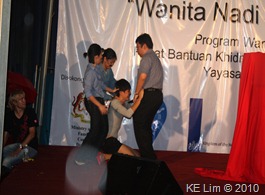
It may not be as real as Poh Si Teng’s acclaimed documentary “Pecah Lobang”, a Freedom Film Fest winner in 2008, but that was the script used by the Bar Council MyConstitution Campaign team to send out a strong message to sex workers and Mak Nyahs at the Jom ke Chow Kit Carnival at Lorong Haji Taib on 31 July 2010.

Joseph2Joseph

Maha2Team Consti4

Above: The MyConstitution Campaign team

It took the team a few days to put together the skit but not without first spending hours after hours debating and deciding on a suitable yet effective message. Most of the team members were lawyers but none of them knew what sort of message would make an impact on one of the oldest professions in the world.

Lawyers are useful when it comes to giving advice on what to do when one is being arrested but what can they tell a highly stigmatised community who not only are prime targets of the police and religious authorities, but also vulnerable to abuse and violence?

Joanna

That was when the team decided to tell the story of Joanna, a transsexual sex worker who died in police custody.

The message was simple. It is louder when four persons scream at the same time than just one. The chances of being heard are higher if you continue to scream. Sooner or later, someone will hear you.

The crowd responded. They laughed and cheered when they saw Celeste, Joanna, Samantha and Lola blowing kisses in the air. The atmosphere turned sombre and quiet when Joanna was being tortured by the officers. Some wore grave expressions on their faces as they watched Celeste bringing news of Joanna’s death and crying out in anguish. They clapped thunderously when the girls came together and agreed to do something about it.

The image of helpless Joanna being forced to face her opponents alone is more real than imagined. Most of us are aware of the discrimination and injustice faced by the community of sex workers, yet we choose to keep silent and stay ignorant of it. While we will readily acknowledge the right to live, life without dignity and justice is not a life worth living.

The organiser, the PT Foundation (PTF), is to be commended for providing an opportunity and platform for people living with HIV/AIDS, sex workers, drug abusers, men-who-have-sex-with-men (MSM), gays, lesbians, bisexuals and transgender people to learn more about their rights and HIV/AIDS. Combating HIV/AIDS is after all one of the UN Millennium Development Goals.

According to the Ministry of Health’s statistics in 2009, there are 86,000 reported cases of HIV/AIDS in Malaysia. Everyday, 15 Malaysians are diagnosed HIV positive and the majority of them are men. 34% are in their twenties. The high-risk groups are surprisingly not sex workers, drug users or homosexuals. They are fishermen, factory workers, long distance drivers, housewives and heterosexuals.

Jeremy
IMG_5563

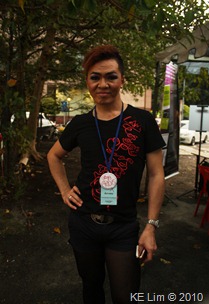
Speaking to Jeremy provided a sense of comfort and assurance. He came across as someone who is wise and easy to talk to; and he is a gay man who occasionally also drags or crossdresses as a woman in special functions such as at the Jom ke Chow Kit Carnival.

Jeremy works towards educating and sensitising people on the importance of safe sex, sexuality and self-acceptance - all the right qualities to help fulfil PTF’s objectives.

I first spotted Jeremy when he was standing in front of the stage with a microphone in his hand. He was giving out a series of HIV/AIDS related trivia. It was difficult not to notice him as he was dressed in a black body-hugging t-shirt, hot pants, black stockings and Mary Jane shoes. In addition to his thick make-up, he was a picture of confidence and determination as he asked the crowd, “Can you get HIV/AIDS by holding someone’s hands?” while loud pumping techno beats were playing on the background.

Later in a private interview, Jeremy disclosed that he had come a long way before his family and friends accepted his sexuality. He was reluctant to call this episode in his life a problem but preferred to see it as a challenge instead. He added that at the end of the day, what’s really important is for a gay person to come to terms with his own sexuality, first. But it is important to take the time to figure out who he really is before arriving at that critical juncture.

When asked whether he faced any discrimination while growing up as a homosexual, he answered no. He explained that Malaysia is that sort of country where you would not get into trouble if you do not tell. An example is how PTF is not allowed to publicly inform people that they provide counselling to gays, lesbians, bisexuals and transgender (GLBT) people. They may only call it “sexuality counselling”.

He also said that while law enforcement authorities do not harass PTF directly, they face many obstacles when trying to implement their HIV/AIDS education and prevention programme for sex workers in massage parlours, karaoke lounges, motels and nightclubs. These places are raided by anti-vice enforcement officers and too often in the presence of PTF, which consequently prevents the businesses from wanting to engage with PTF.

When asked who his hero is, Jeremy declares that he is his own inspiration. His father once told him in an acceptance speech, “Whatever you do, you’re an adult now. You’re responsible for your own life.” He said that it is important for everyone to be themselves because in the end, it is up to each individual to find out who they are and to grow comfortably into their own shoes.

Eddie

Such positive self-image was unfortunately not seen in Eddie, a 39 year-old former drug user. He was seen sitting alone at the back of a tent, quietly colouring his face with bright blue paint.

When I asked him what he was doing at the Carnival, he insisted that I would not be able to stomach his answer. “If I tell you, you won’t be able to take it. So, I rather not say anything,” he said to me again and again and all the while avoiding eye contact.

After some coaxing, he revealed that he is HIV positive. He said most people who learned about his condition would run away. We ended up having a long chat about his life story.

According to Eddie, he started using drugs when he was 15-years old. His family moved to Kuala Lumpur from a small village in Negeri Sembilan. He experienced culture shock and was not able to adapt to city life. Due to existing family problems, he experimented with drugs and it subsequently became a means of escape for him.

He spent most of his adult life in and out of prison and rehabilitation in Sungai Buloh and Kajang. He still remembers starving in prison where inmates were under-fed and often resorted to eating left over fish bones and banana peels. When asked whether he was ever physically abused by prison guards, he replied, “Only if you disobey them. That’s all I’m willing to say.”

He said many inmates died in rehabilitation due to their weak and frail physical conditions, mostly pronounced by poor nutrition. Like him, most of them had no families or friends who would miss their absence. The moment they all discovered how low they had sunk, they would drop out of their lives.

Eddie added, “It hurts. It hurts greatly to see how they looked at me with disgust. Once when I came out of rehab, I had the will to turn over a new leaf. I really wanted to change my life. When I got home, my mother and sisters were busy cooking the whole day. Do you know why? They had planned to feed me well and then send me away for good. I never saw them again.”

When asked whether he is afraid of death, he paused briefly before admitting that he is more afraid of dying a painful death and being alone.

I asked him whether he ever regretted his actions that have led him to this situation, he answered bitterly, “Of course! Who would want to live like this? Because of my health condition and medical treatment, I’m feeling sick all the time. I can’t find work and I have no money or friends.”

Access to assistance

That night, 40 people were arrested by the police on their way to the Carnival which incidentally, was endorsed by the Ministry of Health. They were apparently tested for drugs. As fellow columnist, June Low wrote in her blog, thanks to the police, these 40 individuals missed out on a chance to learn more about the risk of HIV/AIDS.

There is something fundamentally wrong when people are being stopped from having access to help. It is morally sinful when people are being deprived of such an opportunity.

Is it because they are different? Is it because they are considered as moral pariahs?

It is time to ask ourselves these questions.

What makes these people different from us? What makes them so contemptible that we allow them to fight their battles alone? Does that not make us even more contemptible for not coming to their defence?

Finally, how many of us actually give ourselves to others without expecting anything in return; whether it is for love, sex, financial security, companionship, procreation or power?

Answer this truthfully and you’ll know that we are all the same in the end.

I asked Eddie what keeps him alive.

He replied, “What keeps me going is that every year I vow to change my life for the better. I vow to take my methadone and anti-retroviral treatments more diligently. I vow to secure a job to keep me financially independent. I’ll be 40 soon and I think there’s hope. After all, isn’t it true what the Western people say about life beginning at 40?”

The question is: will he live to see that change?

Thursday, October 7, 2010

Voulez-vous coucher avec moi, ce soir?

This article was first published in The Malaysian Insider on 4 October 2010.

IMG_6577

There is one question that often sparks off heated arguments, and to a certain extent, discomfort among the female species rather successfully — including my own circle of girlfriends.

Nothing riles the female species up more than asking them whether human beings are meant to be monogamous. If you want to be really unpopular, try telling them that you actually don’t believe so — which is the position I’m taking.

What I find frustrating when having such a discussion is that the majority of women are not willing or ready to consider my position. I think I can understand why because I used to be one of them. I used to give the same reasons.

“Infidelity is wrong. It shouldn’t be tolerated!” “This is just a bad excuse for men to commit adultery!”

The problem is when women discuss relationships, we tend to idealise and romanticise them. We often talk about who the ideal man is and what a relationship is supposed to be. We can spend hours dissecting the criteria and issues revolving around them and truth be told, there are often many variations at the end of the discussion.

But, when it comes to the topic of fidelity, we often stand unanimous in condemning the act of infidelity wholeheartedly. There is often no discussion but only judgment. I notice the same pattern with my foreign girlfriends.

When I ask the question whether human beings are meant to be monogamous, I am not asking whether polygamous relationships are acceptable or not. When I take the position that human beings are not meant to be monogamous, I’m not saying that I tolerate or accept that we all should have one-night stands with different sexual partners.

I am merely asking us to consider whether it is possible that people commit adultery simply because it is a natural thing to do and not because they stop loving their partner.

The act of infidelity is not a modern phenomenon. It has probably been around since the existence of mankind. The only difference is that it is less tolerated now as modern societies begin to create the concept of marriage as an institution, the religious impositions of the sanctity of marriage, new moral codes regulating the exclusivity of couple-ship, the romantic idealism of fidelity and not least the feminist movement.

The whole concept of one man for one woman, as romantic as it sounds... does it really work for or against the core of human nature?

Now, I was brought up in a society and community which regards fidelity as an obligation. I believe that my parents have been completely faithful to each other although I’ve known some of my relatives who have cheated on their wives. While we try to avert our eyes and pretend that they don’t happen, it is nevertheless a scandal where endless gossip, conversations and debates are held behind closed doors.

The debates are usually divided into two groups as most debates usually are but the interesting thing is, there is absolutely no gender balance in any of the groups. You always get the women thrashing the adulterer while the men are quick to come to his defence.

One of my cousins had a huge fight with her husband when they decided to debate about Clinton’s fidelity. There is nothing better than a healthy discussion on global “affairs”, I’ll say!

Recent studies carried out by several reputable behavioural science research centres in America have shown two surprising changes in American society today, in regards to infidelity. Firstly, the female infidelity rate has increased which means that women are equally unfaithful to their spouses, and secondly more and more young couples are engaging in adulterous relationships.

They claim that modern women now have more opportunities to commit infidelity as they become more emancipated; they get to know more people at the workplace, stay late at work and travel more on business. Previously, when most women were still housewives, they stayed at home all day and hence were less exposed to the possibilities of infidelity. (Have they not heard about how the milkmen and postmen do more than just deliver services?)

They also claim that in this modern era, the Internet and mobile phone have contributed to the increase rate of infidelity. Even housewives can now indulge in flirtations via the Internet and instant text messaging. As for younger couples committing adultery, the Internet is the main culprit.

This I can agree to an extent because with so many online dating services, adult friend finders, etc. it’s so easy for men and women to hook up with someone. Let’s face it, even if you have every intention to stay faithful to your spouse, many profit-making agencies are trying very hard to make you fail. You can hire escort services at just a click of a button by entering your credit card details, preferences and voila!

Look at all the seemingly innocent online social network websites; Facebook, MySpace, etc. Applications like “Are you interested in me?” “Would you like to sleep with me?” are not as innocent as they seem.

Bottomline is, whatever these studies aim to achieve, I think the bigger question is why are people committing infidelity? I don’t think this survey can ever be considered accurate because many people will never own up to being an adulterer. So, they can just stop wasting their time and money on researches.

Society has taught us that infidelity is taboo and it is wrong, but it has never quite prepared us as human beings to deal with such concepts, which are created by presumably religious or impotent people. When this person decided that marriage should be a sacred institution and it is morally sinful to cheat, many of us have followed without ever studying the nature and readiness of humankind. Otherwise, why have so many faltered under the most insignificant temptation?

Then, there are bigger questions like is it possible for a person to love more than two people at a time, or is it possible for a person to fall in and out of love?

A one-night stand to a certain extent is arguably acceptable but what happens when a fling becomes a thing? An affair is no longer harmless because it breaks up a family, which can potentially lead to far-reaching consequences, especially when children are involved.

Various people commit adultery for various reasons. While to many, it is simply unacceptable, it doesn’t really address the issue. Instead, couples need to look at themselves and evaluate what has gone wrong in their relationship to cause either one of them, or both, to be unfaithful.

Has the husband stopped noticing his wife because he is too busy with work? Has the wife stopped being sexually desirable because she is a full-time mother? Have the children become the centre of their lives as a couple?

Or an option would be to study yourself by asking whether you are the faithful type or not. Be honest and own up to it.

Unless these problems are being addressed, be rest assured that infidelity will continue for as long as mankind shall exist.

Saturday, March 27, 2010

Sex, Lies and Videotape by Steven Soderbergh

Sex Lies Videotape One of the first few lessons you learn when trying to market a product is to come up with a catchy name. If that doesn’t work, then aim for a provocative name such as this 1989 movie written and directed by Steven Soderbergh.

I’ve heard the accolades received by this movie and I’ve heard it being quoted in other movies. Naturally, I was intrigued and it wasn’t until tonight that I managed to watch it for the first time.

The verdict? Very interesting and thought-provoking. In fact, it was even better than I thought.

Confession. From the title itself, I first thought that it would be some kind of a raunchy erotica, starring James Spader. Hmm..interesting, right?

Truth be told, if I had watched it several years ago, the movie might have disturbed me as much as Last Tango in Paris is disturbing me now. But fortunately, I think it’s a daring, honest and original screenplay.

If you’re expecting to see Andie McDowell’s naked body in the movie, then you’ll be sorely disappointed. In fact, there is hardly any display of intimate scenes. At least not visually. Instead, you’ll be well compensated and stimulated by its script,  which makes it extremely clever.

I don’t really want to write about what the storyline is all about. Suffice to say that there’s a lot of emotional riddles waiting to be solved bit by bit as the movie progresses and it explores one of the most basic human needs, sex; and methods of self-preservation, lies. The videotape is just a means to get one of them and to expose the other.

I’ll leave with one scene I particularly like just to give you an idea of what I was talking about:

Ann: Did he touch you?
Cynthia: No.
Ann: Did you touch him?
Cynthia: No.
Ann: Did anybody touch anybody?
Cynthia: Well... yes.
Ann: Don't tell me... don't tell me... don't tell me. You didn't!
Cynthia: I did.
Ann: You didn't!
Cynthia: I did.
Ann: You didn't!
Cynthia: I did!

Tuesday, August 18, 2009

The power to change Afghanistan

I am a fan of The Tudors series. I don’t know how accurate the story is but wish that history lessons in school can be made more captivating like the series.

It would seem that King Henry VIII’s reign in England during the 16th century was plagued by religious upheaval; mainly the Lutheran movement in a predominantly Catholic nation and the creation of the Church of England.

The series portrayed King Henry VIII as a monarch who was so obsessed and occupied with his love affairs that he would rule the country with great misjudgement, tyranny and oblivion towards the suffering of his people.

In order to marry Anne Boleyn, he went against the Catholic church (what was considered as the Divine faith) by divorcing his Queen, Catherine of Aragon. This would mark the beginning of England’s separation from the Holy Sea or The Vatican as commonly known today.

King Henry VIII, once discovered the Boleyn family’s plot to manipulate him, ordered for the execution of his new queen. Eventually, he married Jane Seymour who died shortly after giving birth to his first legitimate son.

He then married again for the fourth time to a German aristocrat but succeeded to get the marriage annulled.

This post is not really about the history of England. I’ve mentioned it because there’s one scene in the series which is linked to what I read today on the BBC news.

Apparently, Afghanistan has officially endorsed a law which provides the right for a man to starve his wife if she refuses to have sex with him. It baffles me that such a law should exist in this day and age, especially when Afghanistan is trying to move towards democracy.

To me, instead of moving forward, what’s happening in Afghanistan today is a huge regression towards an archaic period filled with brutality, lawlessness and injustice practised only  by medieval Kings and Emperors granted with unlimited power.

When Jane Seymour was told by Lady Rochford, her lady-in-waiting, that King Henry VIII has taken a mistress, the noble Queen, while feeling dejected, implied that she had accepted the subjugation of women as part and parcel of life. Basically, whatever the King wishes for, it shall be granted without resistance. Whatever he decrees, let it be law.

I couldn’t help but notice too that the King uses religion to suit his whims and fancies. He doesn’t question the sinfulness of debauchery, adultery, corruption and summary executions but will not hesitate to punish those accused of heresy or treason in the name of religion.

Afghanistan is reliving this dark period and I ask myself how could this happen.

The men who support this law stand up boldly and say, this is what our religion says and it is divine. The women, hidden underneath their burqas, remain silent and helpless. In the mean time, what does the President of Afghanistan say?

When I looked at King Henry VIII, he is nothing but a man, made of flesh and blood; pathetic even. He eats, drinks and releases his bowels to stay alive. He falls ill, ages and dies as nature would have predicted him to. And yet, he holds the power to determine who shall live and who shall die.

Who gave him the power? The simple answer is, the people. Without the acceptance of his people to submit themselves to him, he would be nothing but just a common man, like you and I.

A friend asked, "”What can we do for the women in Afghanistan?” The simple answer is, the Afghans themselves. Stop giving power to those who use religion to control and to subjugate. Stop giving power to those who allow these religious fanatics to create senseless and archaic laws.

Stop voting for the person who is responsible for this. Without your support, they will not have the power.

Thursday, June 18, 2009

Sex, thugs and NGOs in Cambodia

Girl in middle

At a cursory glance, it’s easy to regard Phnom Penh as Bangkok’s less developed, poorer and “innocent” cousin. In many ways, this is true.

Here, there are many majestic pagodas situated in almost every corner, making them practical landmarks while navigating the small city. The King and Buddhist monks are highly revered by its people.

Every single day, the drones of four-wheeled tuks-tuks can be heard early in the morning without fail while ubiquitous street vendors accessorize the city landscape.

Like Thailand, there are more than a dozen of cramped markets selling all sorts of cheap silk and wooden handicrafts. The ingredients used in Khmer cuisine are similar to Thai minus the hotness.

Before the recent economic depression, hundreds of thousands of women trooped to work in garment factories, spending hours putting together clothes for big labels such as Gap, Banana Republic, Abercrombie and Finch, Ralph Laurent and Tommy Hilfiger. Earning about USD50 to USD80 a month, most of these clothes cost more than their monthly salary a piece.

Yet, many girls aspire to be garment factory workers. They drop out from schools, leave their homes in the village to attend training for three months before joining their “sisters” in the exploit by industrialized nations. What we spend for USD80 at a fraction of a minute, can feed their entire family for a month.

What makes Phnom Penh innocent compared to Bangkok is the absence of red light districts where  sex industry is part of the tourist attraction. You still see the occasional local young girls escorting “barangs” (foreigners) in the city, but not as conspicuous as in Bangkok.

That’s how most tourists would think of Phnom Penh; just a charming developing city with happy and friendly people. If they have lived here long enough like me, and work in the field that I do, there is a much uglier and sinister side of the city than Bangkok.

Unlike Thailand, majority of the sex workers in Cambodia are being forced into prostitution.

Unlike Thailand, there is no specific districts or locations where strip bars, brothels and sex shows operate on a nightly basis.

Here, everything is carried out more discretely and hence gives the impression that sex is not for sale in Cambodia.  Because it’s so discrete, nobody knows the brutality of this sleazy and inhumane business.

Not only is sex for sale here, the girls and boys are as well. Many of them have been sold by their own family as sex slaves to meet the perpetual sexual demands of expat and local men while temporarily feeding the basic needs of their families.

Phnom Penh_rainy 015 Girls_com Girl close up_2

This is not the only ugly and sinister part. Many of these girls and boys are under the age of 16. Here, it is a paradise for paedophiles.

In Cambodia, the responsibility of taking care of the family lies in the daughter. Boys are often given more opportunity to attend schools while girls remain at home to take care of household chores or get a job.

If this isn’t enough, there is another solution.

They are sold to traffickers or pimps. These girls are supposed to work as prostitutes to pay off their debts. The trick is, they don’t receive any payment in return and hence holding them as financial hostage forever.

Sexual slavery, like any other form of slavery, is a multi-million dollar industry.

If the girls try to escape, they are beaten up, tortured and threatened to death. They receive similar treatment if they don’t smile and seduce customers or have the audacity to reveal any hint of coercion from their handlers. So, customers go on thinking that they sell their bodies voluntarily.

Remember, they don’t even get paid.

Because Cambodia is considered less developed and poorer, it’s infested with hundreds of international NGOs, pouring in millions of dollars to help the people, to free them from any kind of bondage. In the end, the majority of people who do benefit from this “industry” are NGO workers, companies who provide the logistics for NGOs, the government and the lowest of the lower income group.

I recently had the opportunity to visit an international NGO providing free formal education and vocational skills training programmes to children and youths living in Steung Meancheay, a garbage dump in Phnom Penh.

When I entered the training compound, I was astounded by the extravagant infrastructure on its 5 hectare land. After more than one hour of tour around the whole area, I concluded that this is the Disneyland of Vocational Skills Training Centre.

With 600 full time staff and USD5 million annual budget for its operating cost alone, it’s no wonder that the hospitality, cooking, hairdressing and spa training areas are able to simulate what you would get at a five star hotel.

All  200 students are smartly dressed in clean and pressed uniforms. The products used at the hairdressing training are all genuine L’Oreal and Evian brands, none of the counterfeited ones used by the other training centres.

They are even expanding their training centre to include a full size swimming pool, basketball and tennis courts for their students. It’s even better than the school I attended in Malaysia.

The Head of Public Relations told us that all students are guaranteed jobs with the tourism industry upon graduation.

While I listened with great amazement, my heart was filled with sadness. Sadness for the millions of children from low income group who are not able to share such privilege.

I have been visiting many governmental and non-governmental training centres for disadvantaged group in Cambodia. It is part of my job to gather information on how to improve the training curriculum of the NGO I am volunteering for. None of them could ever compete with the Disneyland of Vocational Skills Training Centre. The quality of training is far below reasonable standard and most of the trainees do not benefit from job placement upon graduation.

One day, I asked a local colleague of mine whether any of the rescued women who have been sold as sex slaves (the NGO I work for provides rehabilitation, training and reintegration of trafficked women) comes from Steung Meancheay.

He replied, “None.”

I expressed my surprise, seeing how much poorer the families living in the dumps are and hence presumably more desperate.

He answered solemnly, “Nobody wants to touch these girls from Steung Meacheay. They are dirty and they have diseases.”

Then, it dawned on me. Unless you’re rich or an “untouchable” ; the lowest of the lower income group, you will continue to struggle and suffer like the majority of the people I meet here.

Note: This article was first published at Loyar Burok, a leading human rights portal run by a group of young lawyers in Malaysia.

The Story of O’wnership

200px-Histoire_d_o

I get annoyed with people who pay too much attention on being politically correct. I’m not talking about using discriminatory language. I’m talking about people who pick on every single word you say and then interpret it as politically insensitive.

He’s not black. He’s African.”  “She’s not old. She’s OLD-ER”. She’s not fat, she’s well-endowed.” “He’s not short. He’s vertically challenged.” (Not that vertically challenged is any better!)

Well, let’s call a spade spade, shall we?

Not too long ago, I looked through some materials on discriminatory language for an effective writing course I was conducting. I didn’t realize that so many terms are now considered insensitive.

For instance, we don’t use the term ‘disabled’ anymore. The correct term is ‘people with disabilities’.  An epileptic should be called ‘a person with epilepsy’. You shouldn’t call someone deaf and dumb but ‘a person with a hearing/speaking impairment’. Calling someone a victim of AIDS is incorrect. They are people living with HIV/AIDS.

Unless you’re a diplomat or someone who is working in political, humanitarian or human rights field, it’s difficult to keep up with evolving terms like the ones above.

Recently, I received an email from someone expressing her concern about a reintegration case we were following up on.

We had previously visited a girl who had been rehabilitated and trained at a shelter for rescued victims of sexual exploitation. (Actually, I’ve been told that victim is the wrong term to use, but seriously, how else would you call it? A victim is defined as one who have been harmed by or made to suffer from an act, circumstance, agency, or condition and I believe it qualifies the description.)

This girl had started a small business with the help and support from the NGO I am volunteering for. During the visit, we noticed that her business was not doing well and we offered her some suggestions on how to attract customers, etc.

Anyway, according to the email, this girl has disappeared two days after our visit. Her shop has closed down and all the materials have been vacated. This is obviously very worrying.

However, when I read the person’s email, I got really furious. The person wrote, “I am concerned about her very much and fear that I would lose her forever. If we do not take actions now, we will lose her forever.

This is the funny thing about language. How it has the capacity to be interpreted in many different ways, depending on the writer’s language proficiency as well as the reader’s perceptions of things.

As I mentioned earlier, people who pay too much emphasis on diplomatic language annoy me. At the same time, I have become one of them when I read this email. Do allow me though to explain why it has infuriated me so.

The words ‘I’ and ‘lose’, when coined together implies ownership or possession. To me, the girl belongs to no one. Not her family, not the people who have exploited and used her and definitely not any NGOs or any individual working to help her.

The thought that just because we, the NGO, have given her shelter, medical treatment, training, financial support, etc. does not make her a possession.

Many people have often misinterpret the meaning of love. When we think that we love someone, we feel like possessing them. Families, marriage and relationships imply exclusivity and demand unwavering loyalty and obedience from one another that we often forget that we’re human beings, not objects.

I’ve learned this hard lesson through the relationships I’ve had. The more we think we own someone, the more we fear the thought of losing them. The more we fear losing them, chances are, we will.

If you have not watched the movie The Story of O, you should although I doubt you can find it in Malaysia. It tells the complexity of sexual relationships between a master and slave. We’re not talking about conventional slavery but a voluntary “contract” between a couple where one assumes the position of a master and the other a slave. This contract can be terminated at any time if either one or both wishes it to be.

If you have watched it or perhaps one day have the opportunity to do so, I would like to ask you to try to view it not just as an erotic movie which involves the act of sadomasochism, dominance and submission but an unconventional concept of love and ownership.

There is one scene in the movie where the man explained why he could offer his lover away so easily to other men without any feeling of jealousy or remorse. He said that the fact he could do this showed that he had truly owned her for isn’t it true that only the real master has the “legal” right to do whatever he wants with his possession? And if she decides to return to him after being with other men, then she truly belongs to him.

It’s a really strange concept to grasp but nonetheless a rational one. In such circumstances, perhaps one can say that nobody belongs to anyone unless if someone offers him or herself to someone willingly.

Some would say that the same kind of contract applies to marriage or even employment. But does this imply total control over your spouse or employee’s life? I certainly don’t think so.

Buddha said that the only way to eliminate suffering is when you renounce any kind of desire and this includes the desire to possess.

Tuesday, June 9, 2009

American Romance

Fred Astaire  Ginger Rogers swingtime2

There is something so remarkably uplifting and romantic when you watch Fred Astaire and Ginger Roger gliding and dancing cheek to cheek in the countless number of movies they did together. Then you have something so deeply moving and again, romantic when you see Humphrey Bogart and Ingrid Bergman in a movie like Casablanca.

I can quote a long list of classic American movies made in the 40s and 50s bearing similar theme, but I won’t bore you with it.

I adore American cinema during that time and I believe that it was THE golden era for romantic comedy or drama. Nothing like the present time chick flicks which are made to target specific niche. The good ones are usually those which portray lives back in the olden times when couples still express their feelings in more subtle but dazzling ways. Now, it’s all so garish and impersonal.

The special effect, artistic direction and casting may be way more sophisticated now but they still lack that je ne sais quoi and charm often found in these classic romance. I think the characters in many new movies often lack characters and even the musical score is pale in comparison.

I’ve been watching some romantic chick flicks recently on TV and I’ve come to one conclusion; most of them end in public confessions. If you don’t believe me, take a look at Picture Perfect, Definitely Maybe, Because I Say So, Baby Mama, 27 Dresses, etc. Jerry McGuire’s “you had me at hello” would have been better without the group of divorced women gawking at them.

Whether the confessions are carried out in front of a large group or just one or two people, the couples are never alone. This includes making a public apology. (If only most politicians could learn from that).

27 dresses

I rather like the movie 27 Dresses and almost thought it was romantic in the way that the love interest turned out to be the wedding section writer whom the main character was “secretly” in love with. Then by the end of the movie, she jumped into a private boat wedding, grabbed the microphone and declared her love. Most of you might find such act courageous or even romantic, but if I had an erection then, it went flaccid.

It’s almost as if there’s nothing these couples can’t say in front of anyone, even at the most intimate moment like saying “I love you” or “Marry me”. At the end, what is supposed to be the climax of the movie, the big moment when two persons are about to reveal and share that exclusive conversation is ruined by the thunderous claps of bosses, colleagues, friends and strangers. Whatever shred of romance or dignity left is killed there and then.

And what is with the public proposal thingy?! Is it really romantic or it’s just plain rude for the man to put the woman in such a public spot where saying “No” or “I need to think about it” would make her a spoil sport or a bitch?

Maybe by saying all this makes me a romance killer but excuse me, romance is not about being an exhibitionist or voyeurism. It’s that special emotion, gestures and moment between two people. Don’t you think so?

Call me old fashion but is declaring one’s love or faults in private so passé? I would like to see more movies bringing back that old-fashioned honest-to-goodness kind of romance, rather than the present cliché where there is a need to define romance based on what other people can or cannot see.

Now, I beg of you. If you’re an American reader, I would like to know whether it’s common practice for people to do this in America or it’s just dramatization by movie sellers.

For female readers, do you really think it’s romantic when your man proposes in public? 

Thursday, May 28, 2009

Verbal abuse to be legislated as part of domestic violence in Malaysia?

j0427604

Since nowadays I hardly have the time to surf through the internet for news on Malaysia, I rely a lot on my Facebook friends to update me on something interesting.

Today, someone posted a link from The Star on the proposal to include verbal abuse as part of the Domestic Violence Act. Of course, as usual, the post attracted the attention of some witty fellow friends who couldn’t help but add humour to it. The Star is partly to be blamed for “belittling” the issue by giving it a title “Telling your wife she’s not pretty may soon be an offence”.

Naturally, verbal abuse is not quite the same as making unflattering remarks.

I don’t know exactly how far this proposal has gone or whether it will ever be adopted but it would be interesting to read the actual draft and even more interesting to know about the drafting process itself.

In Malaysia, whenever there is a legal proposal related to women’s rights, one can almost always guarantee protest to the extent of insensitive sexist remarks coming from a specific group of people; well, usually men; may it be law makers or religious authorities.

Mind you, we’re not exactly like many countries in the Middle East, Africa or Asia where women’s rights are considered as taboos but the fact that we still do not have a law against marital rape should explain that we’re not exactly there yet.

So, this proposal is particularly interesting. According to those who made the proposal, verbal abuse is as equally damaging as physical abuse. To many extent, I agree that emotional trauma can have a deeper and longer impact than physical violence. There is a famous saying, sticks and stones may break my bone, but words will kill me.

I found this from an article written by Patricia Evans, Verbal Abuse Precedes Domestic Violence:

Domestic violence is about the control of one human being by another. This control begins with verbal abuse and is similar to mind control. Verbal abuse attacks one’s spirit and sense of self. Verbal abuse attempts to create self doubt. "You don’t know what you’re talking about," "You don’t have a sense of humour," "You can’t take a joke," "You’re too sensitive," "You’re crazy."

Verbal abuse so controls ones mind that some women who have left a verbally and sometimes physically abusive relationship twenty or more years ago still find themselves wondering, "Maybe there’s something I could have done...," or, "Maybe if I’d tried to explain just one more time my relationship would have gotten better." 

While I think it’s a brave and commendable move to regulate verbal abuse, the ultimate challenge facing the victim, offender and members of the judiciary is the burden of proof. It’s hard enough to prove domestic violence when there is an absence of visible marks or scars in cases where women often fail to report the abuse on time, what more verbal abuse? It’s basically my words against yours.

I tend to see verbal abuse and physical violence as similar to rape and sexual harassment because in the end, it’s difficult to draft and implement such law and there are many issues to be considered. 

1) Definition – What is considered as verbal abuse as opposed to “unflattering” or offensive remarks?

For example: Is there a difference between “You’re full of crap”,“Move your fat ass, bitch!”, “You’re a worthless piece of shit!” and “I swear I’ll kill you one day!”?

Sexual harassment is typically defined as unwelcome sexual advances, requests for sexual favours, and other verbal or physical conduct of a sexual nature that tends to create a hostile or offensive work environment. It doesn’t matter whether the offender is aware of his/her action, as long as it makes the victim uncomfortable, it’s considered as harassment.

Would this also apply to verbal abuse? Would it then make a difference if a husband makes a remark as a joke and with no intention to offend? If this is the case, does the wife have the responsibility to tell the husband that such remark hurts her feelings?

Let’s face it, a lot of women, particularly those who have been brought up in conservative societies are likely to take insensitive remarks without much protest.

2) Proof -  Like sexual harassment, verbal abuse will be difficult to prove unless a woman is vigilant enough to wire tape herself before being subjected to verbal aggression or if such abuse takes place in a public place.

Again, in a society such as Malaysia, couples are often careful when it comes to creating a scene in public. Chances are, it will happen at home. Even then, family members tend to turn a deaf ear when it comes to matters between a husband and wife.

3) Victims – Who will be considered as real victims of verbal abuse and according to what and whose standard? What if one woman is particularly more vulnerable than the other?

Will this law apply to men as well or we just assume that women are incapable of verbal abuse and men are simply too “macho” to get hurt?

4) Implementation – would police officers take verbal abuse report seriously or they’ll just simply laugh it off? Even if they don’t, how does one tell an officer that she has been verbally abused without feeling embarrassed or silly, unless it’s a death threat?

Women often don’t report far greater physical abuse for precisely the same reason. They feel shameful and often guilty for allowing herself to be beaten up. Unsurprisingly, they expect police officers not to understand or sympathise with them.

5) Punishment – How do you punish an offender to make sure that it’s fair, adequate and proportionate to the crime committed?

I was curious to know how many countries have legislated such law. It wasn’t easy to find and surprisingly Sierra Leone is one of them. I couldn’t find other more credible jurisprudence yet and I think it’s important to see how this law is being implemented and how effective it is.

The UN Declaration on the Elimination of Violence against Women defines violence against women within the community as ‘physical, sexual and psychological violence within the general community, including rape, sexual abuse, sexual harassment and intimidation at work, educational institutions and elsewhere, and trafficking in women and forced prostitution’. It doesn’t go as far as to spell out verbal abuse.

To sum this up, I acknowledge the harmful impact of verbal abuse and the need to address this issue. At the same time, I also acknowledge how such laws need to be drafted as carefully as possible in order to make a real impact and to avoid any  risk of abuse.

Needless to say, I also think that if we are genuinely concerned about the danger and “criminality” of verbal abuse, then we should also think about children who are being subjected to similar threats; may it be at home or in school.

It’s hardly fair to assume that only women suffer from it.

Wednesday, April 29, 2009

Relationships are skin deep these days

Facialists (beauticians who do  facials) are like 21st century boyfriends. I had this epiphany when I was lying flat on my back, both eyes blinded by two wet cotton pads, listening to the soothing sound of ocean waves while being tended to by a facialist whose name I had absolutely no idea of. There have been too many new facialists over the past year and frankly, I’ve lost count.

There’s one thing which I look forward to everytime when I’m home is a visit to my facial spa; that one sacred place where I get to relax for three uninterrupted hours. But as I laid there yesterday, I realised that I don’t even know the name or face of this new girl who attended to me and felt bad instantly. After all, it’s only fair that one should know the name of the person who almost always manage to make you feel good.

Anyway, I got into thinking; facialists are like boyfriends. They come and they go. Some are good, but mostly bad. For instance, I had one who was so critical of my face. Sure, I am big enough to admit that I don’t have a good complexion, but honey, there’s no need to spell out every single flaw I have. If we all have great skin, you won’t be there in the first place.

Then, there was one who needed reassurance all the time. Is the pressure all right? Am I hurting you? Does this feel OK? OMG! Enough with the questions already! If you stick around long enough, you’ll know what I like. Geez! But still, these ones are not as bad as those who like to inflict pain on you. Oh yeah, I’m talking about those who extract your acne with a bit too much vigour. Damn it! It’s my face, honey. Not a gold mine. The harder you dig, it ain’t gold that is going to pop out.

There’s also the type who is over-zealous when it comes to talking and doesn’t know when she has crossed over the boundary of my own space. What about the ones who are so limp when doing the lymphatic massage that you “don’t feel anything?” Yeah, you know that type of boyfriends I’m referring to.

Anyway, as I said before, not all boyfriends are bad. I miss my first facialist, Ms. Kwan who attended to me for a period of time. She was very attentive and very generous. She would attend to other problem area beyond my face on her own initiative. And Nicky, loved her. She knew exactly what I like without crossing any border. Sadly, they both left. The good ones always seem to leave.

So, it seems that relationships are more or less the same these days. It wasn’t too long ago when most people have longer relationships. Now, they just come and go like my facialists and the more experiences we have, the more we tend to compare them. Unless they get better and better, we often end up reminiscing about the good ones who are probably giving another lucky woman a lot of happiness right now.

Well, on the bright side, at least we’ll have young and beautiful skin at the end of all these facial sessions.

p/s: This applies to men too but since I’m a woman, I’m writing from a woman’s perspective.

p/p/s: In case anyone wonders, the metaphorical examples do not represent my own personal life. :)

Tuesday, March 24, 2009

Mars, Venus, or rather Pluto?

Pluto

Once upon a time, a man and a woman met in the most unexpected circumstances and they fell in love at first sight. After spending months of happy times together and exchanging increasingly frequent I-love-you, they decided that they were meant for each other. Once they got married, things began to change slowly but surely. As the I-love-you became less frequent, fights over the most mundane things in their lives became more, in inverse proportion of course. And so, after many years of unhappiness, they decided that they no longer love each other anymore.

How many of us actually know of such a tale, or for some, even live it? It often occurs to me that it’s easier for two people to be in love when they are not actually living together, contrary to popular belief that distance can be a cause of permanent separation. But why is that?

Well, there are many reasons which can contribute to a breakdown in relationships, but I think one of the main causes is false expectations from both men and women. I’ve always believed that until you live with someone, there’s often no way of really knowing who or how the person is; that is, in their most natural and comfortable environment. During the period of courtship, it’s easier for anyone to be cordial, affectionate, sensitive, understanding and patient. After all, you’re talking about a couple of hours a day, sometimes a week or a month. But when you live with someone, unless you have an innate sweet nature; or you keep multiplying the hours, days and years in which you must continue to make the effort of forgetting yourself and worship the ground that he/she walks on; chances are, you’re bound to be disappointed at some stage, several times, or even all the time.

The truth is, society today hasn’t quite prepared us for this kind of challenges. In the olden days, most couples did not even have a chance to get to know each other before they got married and yet, their marriages seemed to last much longer than now when more and more people are engaging in pre-marital sex and co-habitation.

Ironically, I think women in those days were better informed than us. They entered a marriage without much expectations and above all, they were not told all sorts of lies, regarding men. They were not told that men were in general sensitive, understanding and would worship them for the rest of their lives. Men and women at that time knew their roles very well and they lived by those roles, without much questioning. Were they happier than us? I don’t know. But I do know that most of us are unhappy now.

These days, we find men and women fighting all the time, over who is right and who is wrong. Chick-flick movies do nothing to lower women’s expectations of men. The more we watch, the more we’re convinced that men should personify the hero’s characters; someone who would love and adore us unconditionally. A few days ago, I did one of those Facebook chains of questions and answers thingy on literary geek. My secret fictional crush is Mr. Knightley in Emma by Jane Austen. Boy, I sure wish that I can be with someone like him, but then he wouldn’t be fictional now, would he?

A few years back, I got into a huge fight with my husband because he didn’t make me tea when I was sick. I was angry and upset that he didn’t try to pamper me like I did for him when he was sick. He couldn’t understand why I got so angry because I stopped talking to him for days. When I finally revealed my woes, he burst out laughing much to my further annoyance. All he said was, “If you wanted tea, all you could do was just ask!

So there! Women expect men to have that built-in sensitivity and knowledge of what women want. We do not want to have to ask, we expect men to know automatically and we judge their love for us according to what they know or don’t know.

Is this a classic case of men-are-from-Mars-and-women-from-Venus? I’m beginning to doubt this. I think, we’re all from Pluto. It’s not so much as we don’t know how different men and women are. It’s all about what society makes us believe who we are. Just like Pluto, once believed to be a planet, we are influenced by the media to think that we should be this way or that way.

Unfortunately, reality remains the same. What men are not prepared for is the fact that women have evolved over the years. Somehow, many men still expect women to remain the same, to be like their mothers. Again like Pluto, they think that we’re still part of the planets.

And here’s what I think. I’m not a man-hater but at the same time, I support the advancement of women’s role in society today. Therefore, I’m in no way promoting that men and women should return to where they started. Ultimately, we are all creatures of evolution which will continue to evolve and unfortunately, while we have advanced significantly in many scientific and artistic fields, we have not in terms of personal relationships. We’re still held back by our basic primitive instincts; to attack and defend when threatened.

So I think it’s time for us to start listening more to each other. Whether we like it or not, we are changing as a specie and we need to  acknowledge that if we are to continue to co-exist together, we have to start learning more about each other. False expectations can be overcome through open and honest communications. It’s not about what he or she has bought you for Valentine’s Day, or what he or she has done for you, that is going to reveal who he or she is. To truly know someone, it’s about not having any pre-conceived expectations on that person.

If all this sounds too hard for you, then may I suggest that a black-hole would be a more suitable place for you.

Tuesday, February 17, 2009

A woman’s dignity is in jeopardy and it is our moral obligation to protect her

A woman’s privacy, dignity and physical integrity have been violated. As a woman myself, I would like to show my solidarity for her.

A few days ago, Elisabeth Wong, a Selangor State council member, became a victim of a criminal act, an act which was both malicious and undeserving. Photos and a video showing her in compromising circumstances were circulated publicly with the intention to ruin her reputation and dignity. Many would say, so what? She’s not being molested or raped. Where’s the crime here? The crime begins when they were distributed without her consent and with malicious intent.

Many people were quick to point that finger of judgment at her, particularly politicians from the ruling party, naturally. Unfortunately, by relishing in her misfortune and humiliation, they think that they will be able to rise up in the eyes of the public.

Well, here’s news for you. These male politicians – the fact that you have jumped so quickly on the perpetrators’ side proves how you have all reduced yourself from being a real man and a fellow human beings. Instead of showing compassion and trying to protect a woman’s virtue and honour, you chose to ignore them and glorify the criminal, because at the end, your reactions have fulfilled the  latter’s intention. Elisabeth is not supposed to be punished. What crime did she do? With this, what difference does it make between you and the culprit?

By trying to win this political war, you rejoice on other’s suffering and forget about what it is being a fellow Malaysian and human being. Shame on you and those who will continue to support you. Being a Malaysian, I am ashamed that my fellow  countrymen have reduced themselves to this level.

For the public, I would urge all of you to ignore these photos, and instead try to help protect what’s left of Elisabeth’s dignity. The photos are already out, there’s nothing much we can do, but we can still prevent further damage to her dignity  by not soliciting them. You have a moral obligation not to participate in this and to protect Elisabeth’s privacy.

If a woman does not want you to see her naked and if you insist on doing so, isn’t that a crime? Yes, nobody can stop you and nobody will know because you have the privilege of searching for them in the privacy of your room. But about Elisabeth’s privacy? Did she allow these photos of hers to be viewed by everyone? Did she say that you can look at it?

Elisabeth Wong is a daughter, a sister, a niece, a cousin, maybe an aunt and above all, a woman.Try to exercise your moral conscience to choose what is between right and wrong. Help to protect her dignity as a human being.

Saturday, January 3, 2009

When Mars and Venus are being threatened

I had a long discussion with a friend awhile ago. She’s from one of those post-Soviet Union countries. Perhaps a little bit similar to Malaysia, we are from a generation where we still hang on to certain traditional values but unlike our parents, our lifestyles and mentalities have somewhat changed through influence from the West.

Before I proceed to share the discussion, I need to explain a little bit about my friends’ character in order to better illustrate the point of our discussion.

I see my friend as a modern woman who has her own career, in which she is very good in, sociable and forward thinking. She’s a mother of two young children but don’t expect her to be one of those moms who stay at home and forget about their social life.

I enjoy having conversations with this friend because she speaks her mind and basically, also a fun person to be with. However, there is something about her relationship with her husband which I don’t quite understand. When they are together, it is very clear that they play very different but complementary roles. It’s more or less like he is the chef and she, the sous-chef. Without each other, they will not be able to run a restaurant smoothly.

I guess you must be wondering which part of their relationship don’t I understand as it seems perfect. Anyway, I am not finished yet.

So, an incident happened one night when we were together. We were hanging out at a bar with our husbands and a man who was standing beside her started checking her out. She said something to the man which generated an unexpected reaction from him. He started turning aggressive and we were caught by surprise since we were busy chatting and did not really witness what was happening. To cut a long story short, her husband came to her rescue and finally, the man was ushered out by the security guards. Our night was nevertheless spoiled.

When I later asked my friend what had happened, she explained that she was upset with the fact that the man had the audacity to “give her the eyes” in the presence of her husband. I also observed that during the whole commotion when her husband was about to punch the man in the face, she remained in her seat. I told her that if I were her, I would have punched the man myself.

Then she quickly explained that she could never take such an action in her husband’s presence. It is her husband’s job to protect her and by taking matters into her own hands, she would be undermining her husband’s masculinity.

This is the part I don’t understand. I guess what really confuses me is the paradox between her individual and marital self. I persisted to ask her whether a woman should not be allowed to defend her own honour. Her response eventually generated into another long discussion about the change in man’s role in modern society.

According to her, part of the reasons why women have became the way they are; meaning more bold, bitchy, and out of line, is because of the way men are treating them; meaning more respectful, sensitive and understanding. She was referring to European men. She added that European men do not know how to behave like men anymore and hence, they are being stepped all over by women.

We have very differing views of course and I argued with her that I don’t agree with the way “non-European” men are treating  women. Putting women in subversive positions, treating them as objects, prohibiting them from having individual identities, etc. Are all these what define the masculinity of a man?

I proceeded to tell her that a man who treats women with respect, being attentive to their needs and understands what women want do not make them weak. Masculinity is not measured by how much power or authority a man has over women. It is measured by how he defends a woman’s honour and dignity. There is nothing honourable in treating women like possessions.

In the case of women behaving out of line, I wouldn’t blame it on men. I think it’s mostly due to the nature and personality of the woman in question. These women are just ignorant and lack manners. It doesn’t mean that if you are being treated nicely, you can be rude or mean.

I think that we have to start to understand that we no longer live in an era where women’s options in life were limited due to the lack of education and financial independence. Women are able to obtain the highest level of education and contribute to their nations. They are able to be independent and hence think for themselves. These qualities should not be a threat to men.

The only threat is when both men and women forget the fundamental principles of how to treat each other, as human beings and partners in life.