Wednesday, March 18, 2009

Excusez-moi? What did you say?

I was reading the Cambodian Daily yesterday and came across two articles which just show how oxy-Moron some people can be.

The first article was on an interview by the Los Angeles Times with Saud Usman Nasution, the head of an Indonesian anti-terrorism police squad, Special Detachment 88. The latter spoke in great length about Indonesia’s progress in their fight against terrorism since the Bali bombing. Apparently, the squad has contributed to suppressing terrorism activities within Indonesia, particularly by the Jemaah Islamiah (JI) since 2002. Mr. Nasution is however convinced that the terrorists have no chance to fight back because the squad is working extremely hard to monitor their activities.

Here are some excerpts of the interview:

Q: Just to get the sense of how big the problem is, how many terrorists, roughly, do you think are still out there?

A: We can’t estimate because their organization is underground. They are still actively recruiting. And some sympathizers still support them, so it’s hard to monitor because in Indonesia, especially in villages, there are many people supporting them.

Q: Do you think you have reduced JI to a much smaller, weaker organization than it was in 2002?

A: Yes, of course. Their organization is smaller now. And underground. But before that, they were operational.

Errr….excuse me? What did you say? If they are underground, it doesn’t mean their number has been reduced! The worst thing is, you probably wouldn’t know how much they have grown since they are “underground”.

But nothing can upstage the second article on 73 year-old Josef Fritzl, the Austrian man who has shocked the world when his “underground” activities were exposed. Fritzl has been charged for imprisoning, raping and enslaving his daughter for 24 years, and during the course, fathered seven children with his own daughter.

This was what his lawyer argued. Fritzl will plea guilty to deprivation of liberty, coercion, rape and incest but the charge of enslavement is inappropriate!

Errr…excuse me? What did you just freaking say?!

Tuesday, March 17, 2009

Nobody does wedding like the Cambodians do

Finally awaken Bride and groom

(Photos – The beautiful and lovely wedding couple.)

Love is in the air and you can just feel it when you start to experience road blocks all over the city, hear loud live music which seems to reverberate in your neighbourhood at night and receive more than five wedding invitations in a month. Unfortunately for me, I only received one, but fortunately enough it was the mother of all weddings that I have ever attended.

Yes, this is the month where many young Cambodians decide to tie the knot and they do it with much pomp and circumstance in this hot and dry season. I think that February, March and April are chosen, not because they are considered as auspicious, but more of practicality. In a country where the majority of people still rely on tuk-tuks and motordop (motorcycles) as modes of transportation, the weather is an important factor to ensure a good turn-out at a wedding.

On 1 March 2009, I was honoured to be able to attend the wedding of one of my colleague’s daughter. It was truly a spectacular and colourful event. The traditional and cultural richness could only be matched by the display of brightly coloured and intricate weaving of Cambodian silks on the couple and guests’ attire.

One must be aware that Cambodians take the proverb “the early bird catches the worm” very seriously. As early risers and probably also to take advantage of the temporary cool morning air, the first part of a wedding ceremony usually starts as early as 7am. Traditionally, a Cambodian wedding lasts for 3 days and 3 nights, in association with the 3 jewels of Buddhism; the Buddha, the Sangha (brotherhood of monks) and the Dhamma (the teachings of Buddha). Now, it has been reduced to 1 day in big cities as urbanites get caught up with their hectic city lives.
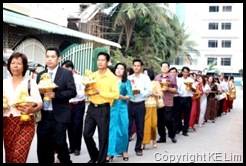
Procession

Gold and silver

Johnie Walker  Gifts

(Photos – The procession. Bottom left: A young girl carrying two bottles of Johnnie Walker. Bottom right: Two smiling ladies carrying trays of dessert.)

A wedding typically starts off with a short procession where the families and friends of the bridegroom carry trays of meticulously wrapped gifts of fruits, dessert, dried food and drinks to the bride’s house. This practice is more of a symbolism now compared to previous times or in the village where the groom comes with a large entourage of people bearing gifts as dowry to the bride. For those who are curious and keen to participate in this, do remember to wear comfortable footwear. (I was not warned beforehand and did suffer a bit walking on my high heels although it was just less than 200m).

Musician Entertainment3

(Photos – The team of musicians, master of ceremony and singer entertaining the guests, leaving them in roars of laughter and delight.)

Once all the guests are settled in the house, married couples gather around the main ceremonial area (usually in a dining hall) in the presence of monks who will officiate the ceremony and the couple’s parents. Traditional music and songs are very important during a wedding for their auspicious meanings and moral values concerning couple relationship, obedience and respect for their parents.

Golden balls Offerings

Food for the gods IMG_3783

Preparing the strings High monk2

(Photos – Carefully arranged gifts, ceremonial items and offerings for the altar.)

While waiting for the bride and groom to make an appearance, I couldn’t help but notice how every single ceremonial item was delicately arranged, wrapped or painted, from the flowers to the offerings. Needless to say, all guests were dressed in their best custom-tailored traditional costumes. I often wonder how many pairs of tailored dresses do the women own and how many times must one pay a visit to the hair salon to get their hair and make-up done? Yes, hair salons are big business in Cambodia where weddings are still considered as a scared part of their lives.

 Breakfast

(Photo – Breakfast)

While the couple and monks get ready for the ceremony, all guests were treated with breakfast, served under a canopy set up in front of the house (and this explains the road congestion if a wedding is held in busy locations). I had one of the most sumptuous breakfast that day when I dug into generous helpings of hot rice noodle soup, served with condiments like bean sprouts, dried shrimps, pickled vegetables, lime juice and yau char kuey (deep fried long pieces of flour dough, usually in pairs). As dessert (yes, dessert even for breakfast!), I tucked into bite-sized sticky rice with desiccated coconut and palm sugar individually wrapped in banana leaves (a bit like the Malaysian version of pulut inti) and an assortment of fresh local fruits.

Bride honouring the groom Bride  

(Photos – Left: The couple giving blessings to each other. Right: A very elegant, beautiful and happy bride.)

Once my stomach was filled, it was time to sit in for the long ceremony. To narrow it down, I have chosen two main rituals; hair cutting and pairing ceremonies. The ceremonies are usually participated by close relatives and friends who are married only, while being observed by other guests. I was given the privilege to partake in the ceremonies due to the host’s hospitality, extended to a foreigner who appreciates live cultural exchanges.

Hair cutting String ceremony2

(Photos – Left: Hair cutting ceremony. Right: Tying of the couple’s wrists by the bride’s parents.)

The hair cutting ceremony represents the fresh start to the couple’s lives as husband and wife. The bride and groom’s hair are symbolically cut first by the master of ceremony, then the couple’s parents and followed by their close relatives and friends. Blessings and wishes for the couple’s happiness, prosperity and longevity are given at the same time. To make their life fragrant, perfume is also sprayed on their hair. The groom will be hard pressed to know that the ignorant foreigner did actually cut off a small piece of his hair!

 Feels better3 Money

(Photos: Gifts for the couple during the string tying ceremony.)

Then, came the more arduous ritual, the pairing ceremony which consists of two parts; tying of the couple’s wrists and seven rotation. I really admire how the couple remain composed, elegant and graceful under the watchful eyes of guests, camera crew and not to mention uncomfortable seating positions and the heat.

Strings that have been immersed in holy water are tied onto the groom’s left wrist and the bride’s right, accompanied by the song that goes like this “We tie your left wrist to make you remember your parents. We tie your right wrist to make you carry on the family lineage and traditions." During this time, relatives take the opportunity to shower the couple with gifts such as jewelleries and money.

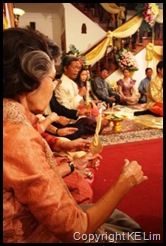
Passing the candles Passing the candles2

(Photos – The seven rotation ceremony.)

Once this is completed, a monk lights up a few bee-wax candles which are passed from one hand to the other around the couple seven times. The flame of the pure bee-wax candle represents anger, which the couple should avoid but the smoke of the flame is sacred enough to protect them from all evils if they are sincerely committed to each other. Family members who receive the candle, motion their hands over the flame to guide the smoke of the sacred flame over the bride and groom.

Wheat pelting

The ceremony was concluded with shower of palm flowers thrown at the new couple.

Albeit being long, I had thoroughly enjoyed this rare occasion. I feel that I had attended the wedding as an ignorant foreigner but returned as an enriched person. I thank the couple and their families for presenting me with this opportunity and wish all of them a lifetime of happiness, peace, good health and prosperity.


Anxious  End

(Photos – Left: The parents of the bride watching the ceremony with mixed feelings; pride but at the same time a hint of sadness as their daughter starts a new chapter of her life. Right: The groom following the bride to mark the completion of the ceremony. In Cambodian culture, the groom stays with the bride’s family once they are married.)

Sunday, March 15, 2009

A cautionary tale for those seeking for the triple “L”

Watermelon

It’s been a long time since I have eaten watermelon with seeds. A few days ago, I bought one from a local fruit stall along the highway from Kampong Chhnang to Phnom Penh. From the look of it, you can tell that it’s organically grown, something which a lot of the Cambodian farmers still practise.

Today, while slicing up the melon, I couldn’t help but moan over the anticipation of picking out the small black seeds, one by one, and there must had been like over fifty or so. Thankfully, the melon was small, unlike those huge ones cultivated by farmers with the help of unnatural pesticides and fertilizers. The worst thing was, the more I slice, the more seeds I found on each cross-section where they were embedded deep inside the pinkish red juicy flesh.

When I began to tediously pop out each seed with a fork, inevitably wasting some juice along the way, a thought came to my mind. Going through all those seeds reminded me of how we often have to go through great pain in life before we can reap the benefits of it.

The organic melon is like love or relationship to me. In order for us to find true love or simply the right one, we often believe that we have to endure a long process of either waiting for something to happen, a difficult and emotionally draining courtship, distance when two people are apart and last but not least, ugly breakups that leave behind scars which remind us not to fall into the same trap again.

And so, some of us tend to approach the possibilities of having a relationship with someone whom we like with much caution. We are so scared and dubious about the person we like for so many reasons; their interest of us, intention, integrity, habits and ambitions, that we ponder, toss and turn in bed, analyze and occupy our minds planning for the next move.

People who are looking for Long Lasting Love (the triple “L”) believe that by taking out each seed of distrust, doubt, uncertainty, frustration, anxiety and pain will then secure us with the benefits of a healthy relationship.

I’ve been told that organic food is better for my health, but once in awhile, I do want to indulge in a piece of processed beef patty in the form of a cheese burger in fast food restaurants. Will I be happy if I stick to a strict regime of organic diet? No, I won’t because I won’t be living. If I don’t live in a country where organic food can be easily found and is cheap, I will be making my own life a misery. In this day and age when social opportunities are endless, it will be impractical and unrealistic for me to demand for organic food when dining with friends.

So for me, relationships are the same. Sometimes, we just need to let go whatever fear we have and adjust our expectations in order to find out what’s really important in our lives; depriving the possibilities of having a good laugh in TGIF, or hunting for organic food alone.

When eating seedless watermelons, I will still enjoy its sweet juicy taste without trying to think about how it will affect my health and the good thing is, I won’t choke on the seeds.

Saturday, March 14, 2009

The 21st Century Slavery (Part VIII)

j0432693

What we’ve learned from our market research assessment

During the last few weeks, we finally carried out our market research project by interviewing four different target groups; 1) residents undertaking vocational skills training courses at three shelters, 2) government and non-governmental vocational skills training centres for women, 3) local small to medium sized businesswomen and 4) international NGOs that implement vocational skills training courses and income-generating programmes for women.  

We have uncovered a wealth of information and at the moment, are still trying to develop an action plan for the reintegration component of AFESIP. The action plan will provide recommendations on whether to expand or improve the training curriculum at AFESIP’s shelters (or both) and if yes, what courses should be implemented or act as a supplement to the existing courses; hairdressing and sewing.

What do the residents say?

Interview

About 150 women were interviewed based on a series of questions and a list of 21 training options were given to them in the forms of pictures (see photo above). They were asked to choose 3 training courses which they would like to take if they are each given more options than the current ones .

Our questionnaire revealed that majority (more than 70%) of the residents at the shelter will return to their families in the village after they complete their vocational skills training courses. While majority of them are happy with the current two training courses, an overwhelming number would like to have some form of computer lessons and if they are given more options, many would like to choose agriculture (particularly fish-raising), cooking, running small businesses, tourism and traditional dancing courses.

Surprisingly (or rather unsurprisingly), none of these women chose housekeeping as an alternative course. We are uncertain as to whether the reason was because most of the women do not feel that they need to be trained on domestic science or that they do not want to pursue a career as a domestic helper.

What we learned from the government and non-governmental vocational training centres for disadvantaged women

We visited several training centres in Phnom Penh, Kampong Chhnang, Kampong Cham, Kampong Speu and Siem Reap. It was interesting that all the centres provide the same courses; hairdressing and sewing. Some offer silk weaving and food processing as well. It’s easy to understand why training options are limited to these and but at the same time, difficult to imagine that such homogenous career paths can help the women to become more competitive in the market. In the end, it feels as if all the women will become either a hairdresser, tailor or garment factory workers.

One of the main reasons that hairdressing, sewing and silk weaving trainings are such popular options is because majority of these women have very low education level. These training courses do not need much literacy skills and at the same time, there is a high and consistent demand for hairdressing and tailoring services in a country where weddings and cultural ceremonies are part and parcel of community living all over the country. Cambodia is also a country which depends heavily on its garment industry where big labels like Gap, Banana Republic, Abercrombie and Finch, etc. are being outsourced here. Nevertheless, there has always been a fear that these labels may not stay for long in Cambodia once economic trade agreements change and other less developing countries begin to provide cheaper labour.

The other thing we learned is that in order for these centres to be sustainable, it needs to form network and partnership with international organizations, governmental agencies, financial institutions and business associations. The Ministry of Women’s Affairs (MoWA), Ministry of Labour and Vocational Trainings (MoLVT), International Labour Organization (ILO), UNDP, Asian Development Bank (ADB), JICA and World Bank are the key partners in programmes like this.

- to be continued -

Sunday, March 8, 2009

What does the reader think of Him Huy?

Him Huy 

If Kate Winslet’s character as Hanna Schmitz in The Reader won her an Oscar, Him Huy didn’t. Him Huy was the head of the prison department in Tuol Sleng or commonly known as the S-21 where thousands of Cambodians were executed during the Khmer Rouge regime. From 1975 to 1979, 1.7 million Cambodians died of starvation, extreme labour, torture and executions.

Him Huy, now 53 lives in a village  80km from Phnom Penh recalled some of the memories from the time he served under Duch, one of the five senior officials on trial at the Khmer Rouge tribunal at the moment. In his village, he works as a farmer and appears to be well-liked by his neighbours. The father of nine children is said to be optimistic, hardworking and quick to smile.

“Yes, I did kill people,” he testified in an interview carried out by the International Herald Tribune. “I did transport people to Choeung Ek. I did verify lists of people of Choeung Ek. But Duch ordered me to do all that.” He also added, “I had no choice. If I hadn’t killed them. I would have been killed myself.”

Many prisoners held at the S-21 were executed by iron bars swung at the back of their heads with their hands tied behind them while kneeling down in front of a huge pit which had been dug out to bury the bodies. “I used an iron bar about that long,” Him Huy said spreading his hands wide, “and about as thick as my big toe.”

Although Him Huy claimed that he had personally killed five people, one of the S-21 survivors and two of his co-workers quoted him as mean, a seasonal killer who was an important figure at the prison and key participant in the execution process.

When asked whether he feels any remorse or guilt over what he did, Him Huy said, “I am a victim of the Khmer Rouge.” He was evasive about the extent of his duties as head of the prison department but insisted that whatever he did was driven by the fear of being killed. When asked to describe himself, he said, “I’m not a bad person. I’m a good man. I never argue with anyone. I have good intentions as a human being.”

During the trials, many have raised the questions about the guilt of lower-ranking officials like Him Huy, many of whom may never face trial. Surprisingly, the issue of forgiveness reserves no contention for some survivors who have willingly accepted that those  who were forced to carry out orders are blameless.

A recent survey carried out by the Documentation Centre of Cambodia in February revealed that out of 1,110 Cambodians in 186 districts, 56.8 percent support the pursuit of more defendants for the Khmer Rouge trial. Although this is only a small marginal difference, it was mostly the  young Cambodians who have expressed the most support, perhaps being more aware of what is right and wrong compared to the older generation, who are governed by traditional values such as forgiveness. 37.6 percent of those who don’t support this feels that there might be a risk of public disorder.

As someone who is not a Cambodian, I thought that it would be easy for me to pass on judgment and condemn officials who have carried out the torture and mass executions of civilians during the Khmer Rouge regime. However, it is not.

I realize that this is a difficult issue to be reckoned with. As the survivor who was mentioned above said, “I don’t know what I would have done in his place. I don’t think I would have been able to disobey.” I tried to put myself in Him Huy’s position and truthfully, I cannot in all certainty say that I rather be killed. But, if an iron bar were to be put in my hand and I was forced to take a hard swing against a helpless person, I am not sure whether I will be able to do it. But if I did, I think I will feel damn remorse and guilty as hell, even if it was under threat.

The other question would be how do we know that someone has been genuinely forced to carry out orders? Or, maybe it could have started off as an order which gradually becomes a form of power enjoyed by the person? If we were to excuse people like Him Huy, will it not be used as an excuse by those who have willingly participated in mass executions?

Him Huy might be the real version of Hanna Schmitz, a person who genuinely thought that what he did was right. The only difference is, he did not go to prison.

As a reader, what do you think?

Wednesday, March 4, 2009

Innocent until proven guilty at a domestic level

Two nights ago I received a disturbing news about our domestic helper in Phnom Penh. I was told by my husband who was informed by his office staff who had received a call from our apartment owner. Yes, we were not told directly because we had been away for one week. It seems that “K”, the domestic helper in question, had come into the apartment one night while we were away, with a large laundry bag. One can easily deduce that she was doing her laundry in our apartment without us knowing.

Anyway, when I first heard about it, my reaction was one of ambivalence. It takes years of life experiences and lessons learned to teach me that nothing is black and white and so, I didn’t jump into any conclusion. In fact, there could be one hundred and one possibilities why this news has reached us in this manner.

First of all, during the five months that K has been working with us, she has never given us any reason to doubt her integrity. In fact, we have been rather happy with her work performance and character in general and therefore, trust her to look after our apartment while we are away, which happens a lot.

Secondly, being a cynic, I don’t really trust anyone and this includes my husband’s office staff, the apartment owner and the guard, who had purportedly reported K’s suspicious activities. So, since I did not personally catch K in action, I rather not execute a guilty verdict before getting to the bottom of things.

Then, on the same night that I received the news, I received a call from K. Basically, she confirmed the report by admitting to the fact that she had indeed brought her laundry to our apartment. She was apologetic but by then, my feelings weren’t as neutral as before. If anything, I was upset that she had deliberately hide it from me as she didn’t say anything when I saw her earlier that day. In fact, all she did was asked me to allow her to take three days off which was granted immediately. The thought that she had come clear with me only after knowing that the cat is out of the bag, upset me further. Nevertheless, I tried my best to sound calm and told her that we would talk when I see her next.

The next day, my anger started brewing more and more when I thought about her betrayal. The thing is, it wasn’t so much as the fact that she exploited our resources for her own gain but more of the way she had returned our good will and understanding. It was only two months ago when we had increased her salary which apparently is rather good for the number of hours she works for us. We have been very flexible with her in the way that as long as she does her work well, we don’t really care or keep tab of how she manages her work. We knew that she is holding two jobs and often comes in to clean for two hours and then leaves for another shift somewhere else. Unlike other domestic helpers who work six full days a week and  getting the same salary, she has it easy with us.

When I talked to my colleague about it, she further convinced me that K has breached our trust and hence can never be trusted again and I should get rid of her while I can. She also told me that I could get a replacement easily. Usually, this would have been the easiest solution but instead I chose not to be rash. I needed to hear K’s side of the story first.

I talked to K today and it turns out that she does have an explanation for her behaviour, furnished with scientific evidence. She has been diagnosed with severe sinusitis and the doctor has advised her not to inhale washing powder while hand washing her laundry. Usually, her sister-in-law does the laundry but coincidentally, she was away the same week that we were away. As a result, she came to the apartment to use our washing machine.

I told her strictly that while I feel sorry for her condition, I wished that she would have told us first. I tried to make her understand that honesty and trust are the most important principles we look for in a domestic helper. I understand that she has every reason not to tell us for fear that we would not understand but at the same time, I want her to know that what she did was wrong and dishonest and we are not unreasonable and unreliable employers. I don’t know why, but when she finally broke into tears, I could sense that she feels genuinely sorry for what she did.

My other principle is that for the kind of mistake she did, she deserves a second chance and a benefit of a doubt. And so, I told her that in future, she should come to us first if she needs something from us and if we ever hear from someone else about any misconduct from her, I will not tolerate it again.

The point of this story is that as employers, we often neglect to take the time to communicate or talk to our employees. We tend to choose the easiest solution such as getting rid of a problem without understanding the cause. In this day and age, we often get caught up with work and if we can save our time from having to deal with petty issues such as this one, we will.

We also tend to lose sight of how things are from the other side. I tried to put myself in her position and I can tell you that being a domestic helper is not such a fantastic job. Being a mother who struggles to give her 6 year-old daughter a good education by holding two jobs, it makes sense for her to think that it costs us nothing for one, two or maybe three loads of washing.

Whether K was being completely honest or not, I would never know but for now, I choose to listen to her and give her my benefit of a doubt because she has provided me with a satisfactory explanation and evidence to prove her innocence. Who knows? I might get screwed in the end for being compassionate and fair, but I rather not break her spirit and cause her to lose a job, if she was indeed innocent.